

1
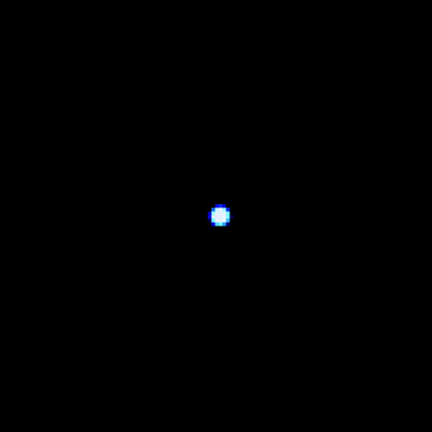
Chandra X-ray Image of GRB 031203
Monitoring of the afterglow of GRB 031203, a gamma-ray burst 1.3 billion light years from Earth, with Chandra and other telescopes showed it was an unusual gamma-ray burst that radiated only a fraction of the energy of a normal gamma ray burst. Gamma-ray bursts, like supernovas are thought to be produced by the collapse of the core of a massive star. Many examples exist where the core collapses to form a neutron star, resulting in a supernova. But what occurs when a core collapses to form a black hole is uncertain. The discovery of substandard gamma-ray bursts should give astronomers valuable clues to the processes responsible for supernovas, black hole formation, and gamma ray bursts.
(Credit: NASA/CXC/Caltech/A.Soderberg et al.)
Scale: Image is 1 arcmin per side.
Monitoring of the afterglow of GRB 031203, a gamma-ray burst 1.3 billion light years from Earth, with Chandra and other telescopes showed it was an unusual gamma-ray burst that radiated only a fraction of the energy of a normal gamma ray burst. Gamma-ray bursts, like supernovas are thought to be produced by the collapse of the core of a massive star. Many examples exist where the core collapses to form a neutron star, resulting in a supernova. But what occurs when a core collapses to form a black hole is uncertain. The discovery of substandard gamma-ray bursts should give astronomers valuable clues to the processes responsible for supernovas, black hole formation, and gamma ray bursts.
(Credit: NASA/CXC/Caltech/A.Soderberg et al.)
Scale: Image is 1 arcmin per side.
2
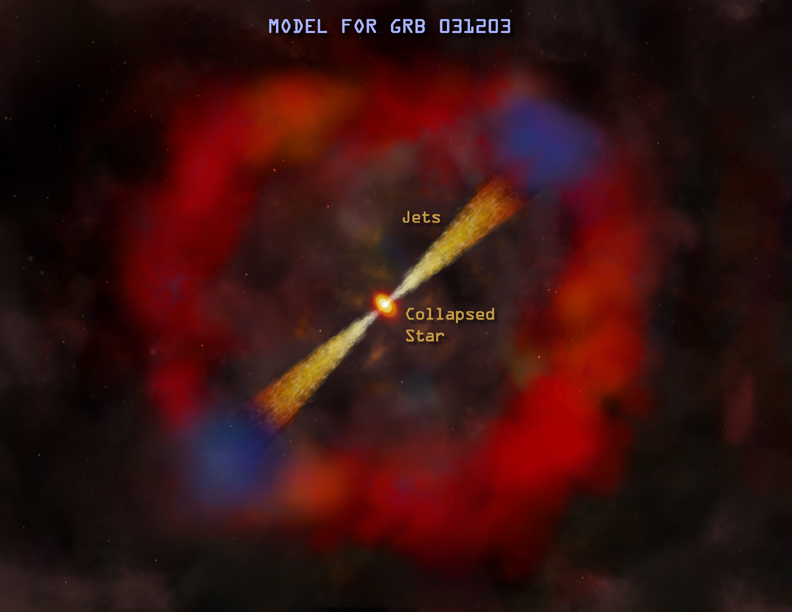
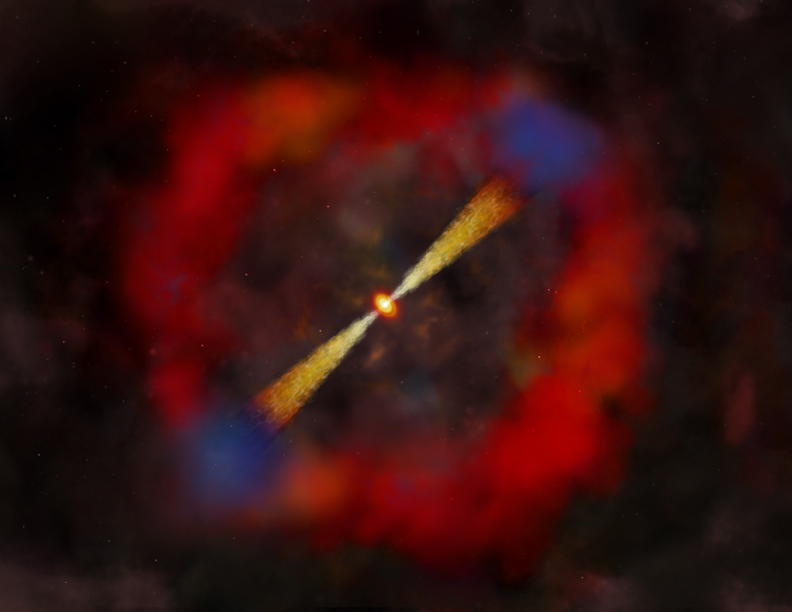
Model of a Gamma-ray Burst
Many scientists believe that gamma-ray bursts are caused by jets of high-energy particles from a rapidly rotating black hole that interacts with surrounding material. This artist's rendering depicts this model (not to scale), where the black hole is produced by the collapse of a massive star's core.
(Illustration: NASA/CXC/M.Weiss)
Many scientists believe that gamma-ray bursts are caused by jets of high-energy particles from a rapidly rotating black hole that interacts with surrounding material. This artist's rendering depicts this model (not to scale), where the black hole is produced by the collapse of a massive star's core.
(Illustration: NASA/CXC/M.Weiss)
Return to GRB 031203 (04 Aug 04)




Revised: May 17, 2022