

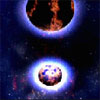
Colliding Binary Neutron Stars
Quicktime MPEG Gamma-ray bursts are common, yet random, and fleeting events that have mystified astronomers since their discovery in the late 1960s. Many scientists say longer bursts (more than four seconds in duration) are caused by massive star explosions; shorter bursts (less than two seconds in duration) are caused by mergers of binary systems with black holes or neutron stars. This animation portrays one possible scenario that could produce the shorter bursts. While uncertainty remains, most scientists say in either scenario a new black hole is born.
[Runtime: 0:23]
(Credit: NASA/D.Berry)
Quicktime MPEG Gamma-ray bursts are common, yet random, and fleeting events that have mystified astronomers since their discovery in the late 1960s. Many scientists say longer bursts (more than four seconds in duration) are caused by massive star explosions; shorter bursts (less than two seconds in duration) are caused by mergers of binary systems with black holes or neutron stars. This animation portrays one possible scenario that could produce the shorter bursts. While uncertainty remains, most scientists say in either scenario a new black hole is born.
[Runtime: 0:23]
(Credit: NASA/D.Berry)
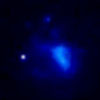
Multiwavelength Views of GRB 050709
Quicktime MPEG Various observatories watch the July 9, 2005 Gamma-Ray Burst (GRB) afterglow. A team lead by Dr. Derek Fox discovered the X-ray afterglow with NASA's Chandra X-ray Observatory; a team led by Prof. Jens Hjorth of the University of Copenhagen then identified the optical afterglow using the Danish 1.5-meter telescope at the La Silla Observatory in Chile. Fox's team continued its study of the GRB afterglow with NASA's Hubble Space Telescope.
[Runtime: 0:31]
(Credit: NASA/University of Copenhagen)
Quicktime MPEG Various observatories watch the July 9, 2005 Gamma-Ray Burst (GRB) afterglow. A team lead by Dr. Derek Fox discovered the X-ray afterglow with NASA's Chandra X-ray Observatory; a team led by Prof. Jens Hjorth of the University of Copenhagen then identified the optical afterglow using the Danish 1.5-meter telescope at the La Silla Observatory in Chile. Fox's team continued its study of the GRB afterglow with NASA's Hubble Space Telescope.
[Runtime: 0:31]
(Credit: NASA/University of Copenhagen)
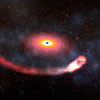
Black Hole Devours a Neutron Star
Quicktime MPEG Scientists say they have seen tantalizing, first-time evidence of a black hole eating a neutron star-first stretching the neutron star into a crescent, swallowing it, and then gulping up crumbs of the broken star in the minutes and hours that followed.
[Runtime: 0:28]
(Credit: NASA/D.Berry)
Quicktime MPEG Scientists say they have seen tantalizing, first-time evidence of a black hole eating a neutron star-first stretching the neutron star into a crescent, swallowing it, and then gulping up crumbs of the broken star in the minutes and hours that followed.
[Runtime: 0:28]
(Credit: NASA/D.Berry)
Return to GRB 050709 (05 Oct 05)




Revised: April 22, 2020