

Download Image


More Information


More Images
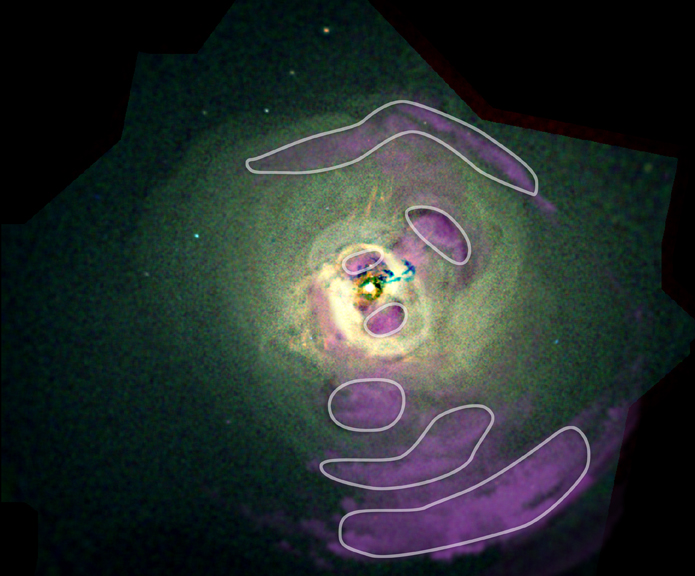
Chandra Image of Perseus Cluster with Overlay of Low Pressure Region
(Credit: NASA/CXC/IoA/J.Sanders et al.)

Animation & Video

More Releases


Related Images


Perseus Cluster:
Chandra Proves Black Hole Influence is Far Reaching

Credit: NASA/CXC/IoA/A.Fabian et al.


Chandra Proves Black Hole Influence is Far Reaching
Credit: NASA/CXC/IoA/A.Fabian et al.
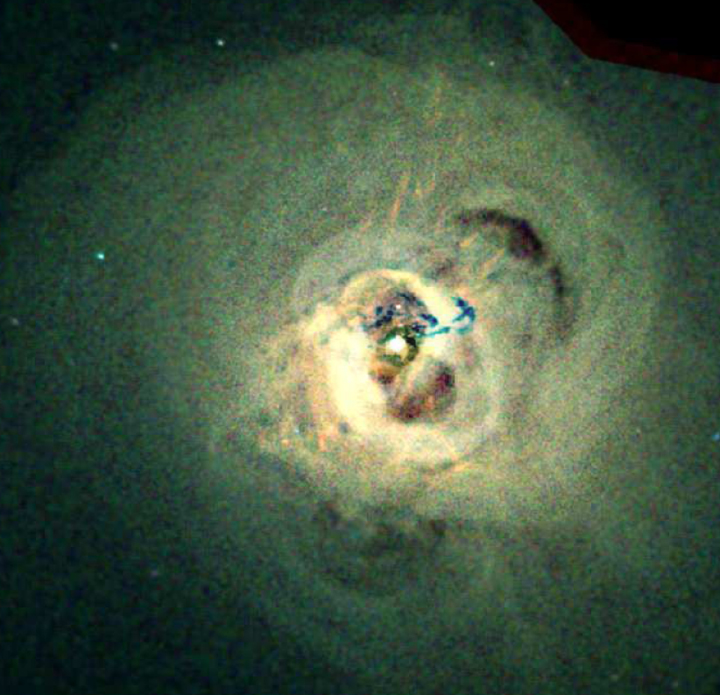
An accumulation of 270 hours of Chandra observations of the central regions of the Perseus galaxy cluster reveals evidence of the turmoil that has wracked the cluster for hundreds of millions of years. One of the most massive objects in the universe, the cluster contains thousands of galaxies immersed in a vast cloud of multimillion degree gas with the mass equivalent of trillions of suns.
Enormous bright loops, ripples, and jet-like streaks are apparent in the image. The dark blue filaments in the center are likely due to a galaxy that has been torn apart and is falling into NGC 1275, a.k.a. Perseus A, the giant galaxy that lies at the center of the cluster.
Special processing designed to bring out low and high pressure regions in the hot gas has uncovered huge low pressure regions (shown in purple in the accompanying image overlay, and outlined with the white contour). These low pressure regions appear as expanding plumes that extend outward 300,000 light years from the supermassive black hole in NGC 1275.
The hot gas pressure is assumed to be low in the plumes because unseen bubbles of high-energy particles have displaced the gas. The plumes are due to explosive venting from the vicinity of the supermassive black hole.
The venting produces sound waves which heat the gas throughout the inner regions of the cluster and prevent the gas from cooling and making stars at a high rate. This process has slowed the growth of one of the largest galaxies in the Universe. It provides a dramatic example of how a relatively tiny, but massive, black hole at the center of a galaxy can control the heating and cooling behavior of gas far beyond the confines of the galaxy.
|
||||||||||||||||||||||||||||||


Revised: June 07, 2022