

1

Chandra X-ray Images of Cassiopeia A
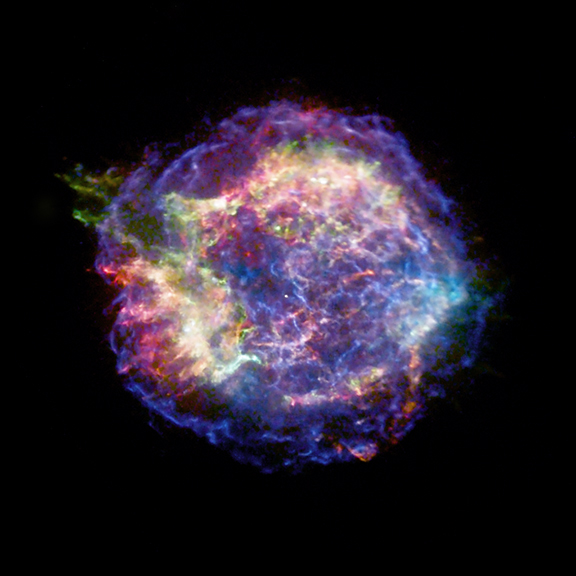
A movie of X-ray data from Chandra of the supernova remnant Cassiopeia A (Cas A) was made by combining observations taken in January 2000, February 2002, February 2004, and December 2007. In these individual images, the lowest-energy X-rays Chandra detects are shown in red, intermediate energies in green, and the highest energies in blue. Scientists have used the movie to measure the expansion velocity of the leading edge of the explosion's outer blast wave (shown in blue). The researchers find that the velocity is 11 million miles per hour, which is significantly slower than expected for an explosion with the energy estimated to have been released in Cas A. View Movie
Credit: NASA/CXC/SAO/D.Patnaude et al.
A movie of X-ray data from Chandra of the supernova remnant Cassiopeia A (Cas A) was made by combining observations taken in January 2000, February 2002, February 2004, and December 2007. In these individual images, the lowest-energy X-rays Chandra detects are shown in red, intermediate energies in green, and the highest energies in blue. Scientists have used the movie to measure the expansion velocity of the leading edge of the explosion's outer blast wave (shown in blue). The researchers find that the velocity is 11 million miles per hour, which is significantly slower than expected for an explosion with the energy estimated to have been released in Cas A. View Movie
Credit: NASA/CXC/SAO/D.Patnaude et al.
2
X-ray Data from Chandra
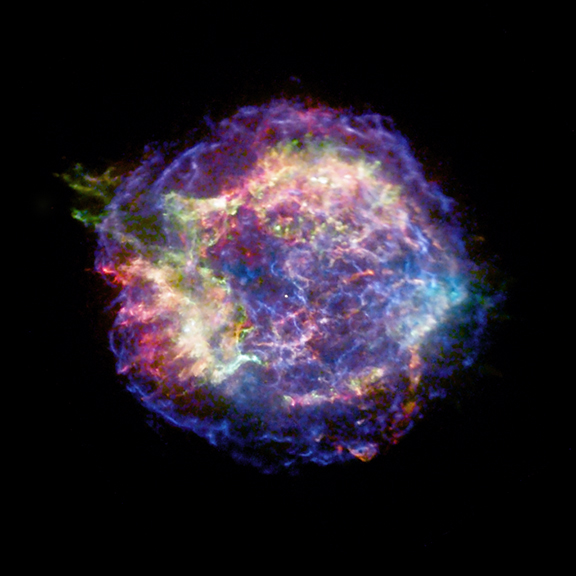
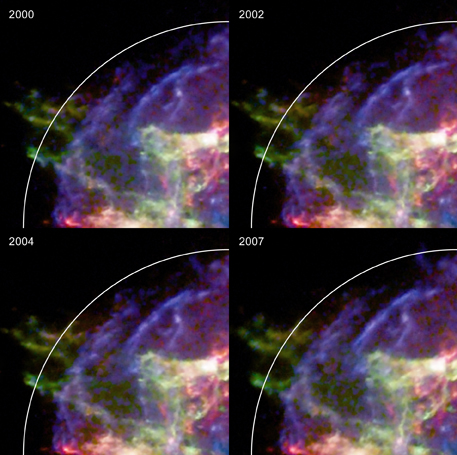
A movie of X-ray data from Chandra was made by combining observations taken in January 2000, February 2002, February 2004, and December 2007. In these still images taken from the movie, the lowest-energy X-rays Chandra detects are shown in red, intermediate energies in green, and the highest energies in blue. Scientists have used the movie to measure the expansion velocity of the leading edge of the explosion's outer blast wave (shown in blue). The researchers find that the velocity is 11 million miles per hour, which is significantly slower than expected for an explosion with the energy estimated to have been released in Cas A. View Movie
(Credit: NASA/CXC/SAO/D.Patnaude et al.)
A movie of X-ray data from Chandra was made by combining observations taken in January 2000, February 2002, February 2004, and December 2007. In these still images taken from the movie, the lowest-energy X-rays Chandra detects are shown in red, intermediate energies in green, and the highest energies in blue. Scientists have used the movie to measure the expansion velocity of the leading edge of the explosion's outer blast wave (shown in blue). The researchers find that the velocity is 11 million miles per hour, which is significantly slower than expected for an explosion with the energy estimated to have been released in Cas A. View Movie
(Credit: NASA/CXC/SAO/D.Patnaude et al.)
3


X-ray Data from Chandra, Less Saturated Colors
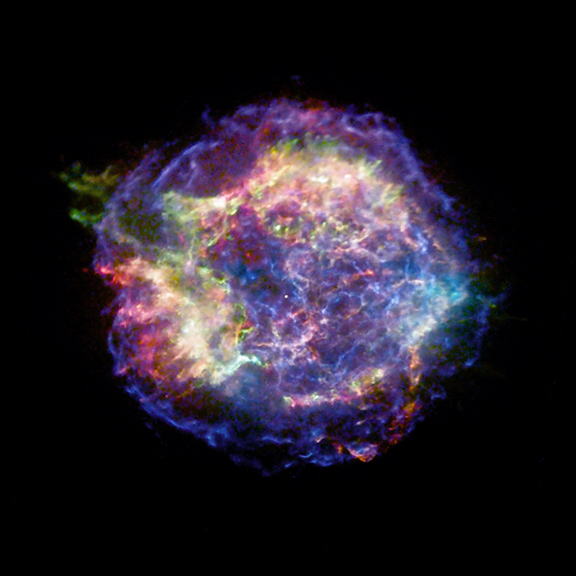
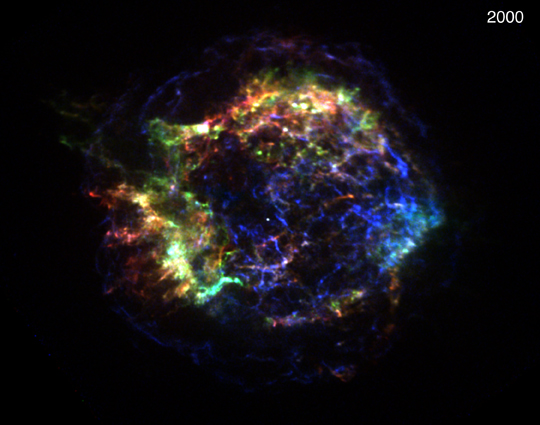
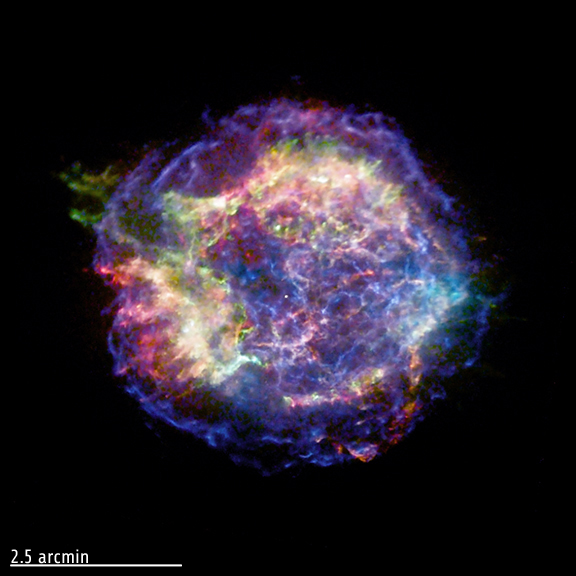
A movie of X-ray data from Chandra of Cas A was made by combining observations taken in January 2000, February 2002, February 2004, and December 2007. In these still images, the lowest-energy X-rays Chandra detects are shown in red, intermediate energies in green, and the highest energies in blue. Scientists have used the movie to measure the expansion velocity of the leading edge of the explosion's outer blast wave (shown in blue). The researchers find that the velocity is 11 million miles per hour, which is significantly slower than expected for an explosion with the energy estimated to have been released in Cas A. View Movie
Credit: NASA/CXC/SAO/D.Patnaude et al.
A movie of X-ray data from Chandra of Cas A was made by combining observations taken in January 2000, February 2002, February 2004, and December 2007. In these still images, the lowest-energy X-rays Chandra detects are shown in red, intermediate energies in green, and the highest energies in blue. Scientists have used the movie to measure the expansion velocity of the leading edge of the explosion's outer blast wave (shown in blue). The researchers find that the velocity is 11 million miles per hour, which is significantly slower than expected for an explosion with the energy estimated to have been released in Cas A. View Movie
Credit: NASA/CXC/SAO/D.Patnaude et al.
Return to Cassiopeia A (January 6, 2009)




Revised: December 01, 2022