WHO: The 101st object in astronomer Charles
Messier's catalog is commonly known as M101 or
the Pinwheel Galaxy.
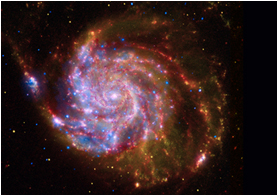
WHAT: Like the Milky Way, M101 is a spiral galaxy.
The most notable features of these galaxies are
the graceful spiral structures arcing out from their
centers.
WHERE: M101 is located at a distance of about 25 million
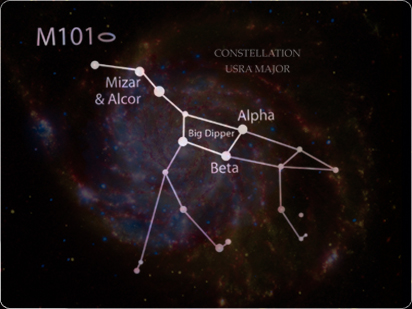
light years from Earth in the constellation Ursa
Major, the "bear." From the ground, M101 can be seen
just off the handle of the Big Dipper with a small telescope
or binoculars.
WHEN: The objects in M101 have a wide variety of
ages ranging from newborn stars to globular clusters
containing stars that are billions of years old.
HOW: X-rays show superheated material throughout
M101, while infrared and optical data outline the
cooler dust and young stars in the spiral arms of the
galaxy.
WHY: Since Earth is located within the Milky Way's
flat, thin disk, it is impossible for us to see in its entirety.
Instead, by observing other spiral galaxies that
are oriented "face on" to us, like M101, we can better
understand our home galaxy.
X-rays from
NASA's Chandra
Optical data
from NASA's Hubble
Infrared emision
from NASA's Spitzer