


Download Image


More Information


More Images
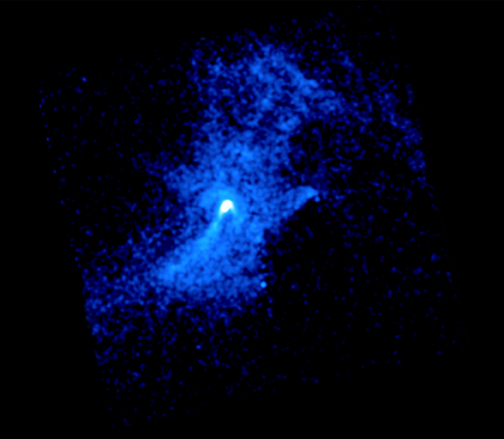
X-ray Chandra image - Code: Energy
(Credit: NASA/CXC/MIT/B.Gaensler et al.)

Related Images


B1509-58 in SNR G320.4-1.2:
Chandra Examines A Quadrillion-volt Pulsar
Credit: NASA/MIT/B.Gaensler et al.


Chandra Examines A Quadrillion-volt Pulsar
Credit: NASA/MIT/B.Gaensler et al.
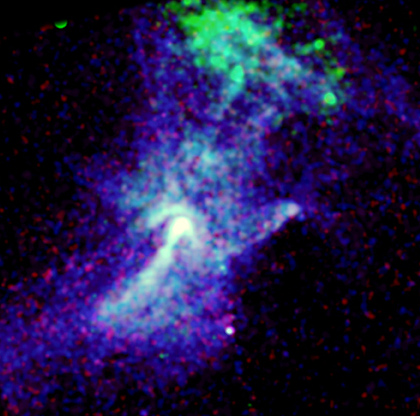
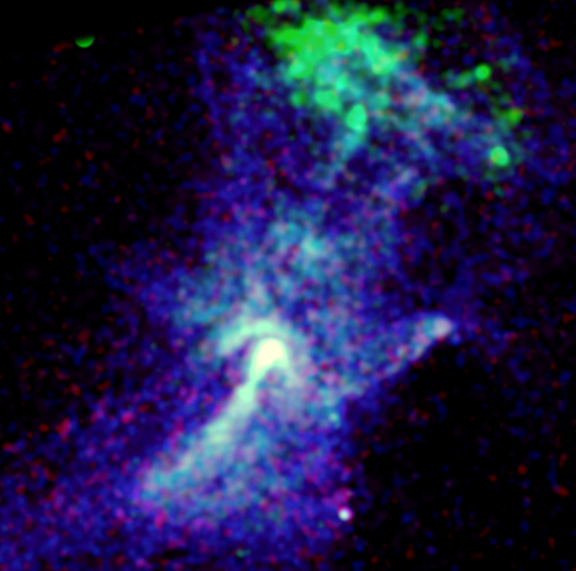
This Chandra image gave astronomers their first view of the energetic and complex nebula surrounding the young pulsar PSR B1509-58. The blue and purple colors indicate X-rays emitted by high-energy particles of matter and anti-matter which stream away from the pulsar. The pulsar itself is the bright white source at the center of the nebula.
A thin jet, almost 20 light years in length, extends to the lower left, and traces a beam of particles being shot out from the pulsar's south pole at more than 130 million miles per hour. Just above the pulsar can be seen a small arc of X-ray emission, which marks a shock wave produced by particles flowing away from the pulsar's equator.
The green cloud near the top of the image is due to multimillion degree Celsius gas. This gas, possibly a remnant of the supernova explosion associated with the creation of the pulsar, may have been heated by collisions with high-energy particles produced by the pulsar.
|
||||||||||||||||||||||||||


Revised: June 04, 2022