

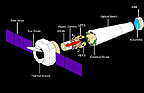
Chandra X-ray Observatory
The Chandra X-Ray Observatory combines the mirrors with four science instruments to capture and probe the X-rays from astronomical sources. The incoming X-rays are focused by the mirrors to a tiny spot (about half as wide as a human hair) on the focal plane, about 30 feet away. The focal plane science instruments, ACIS and HRC, are well matched to capture the sharp images formed by the mirrors and to provide information about the incoming X-rays: their number, position, energy and time of arrival.
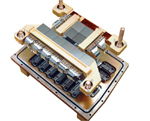
ACIS
Two additional science instruments provide detailed information about the X-ray energy, the LETG and HETG spectrometers. These are grating arrays which can be flipped into the path of the X-rays just behind the mirrors, where they redirect ( diffract ) the X-rays according to their energy. The X-ray position is measured by HRC or ACIS, so that the exact energy can be determined. The science instruments have complementary capabilities to record and analyze X-ray images of celestial objects and probe their physical conditions with unprecedented accuracy.
High Resolution Camera (HRC)
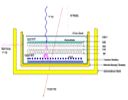
HRC Illustration
The High Resolution Camera (HRC) is one of two instruments used at the focus of Chandra, where it detects X-rays reflected from an assembly of eight mirrors. The unique capabilities of the (HRC) stem from the close match of its imaging capability to the focusing power of the mirrors. When used with the Chandra mirrors, the (HRC) can make images that reveal detail as small as one-half an arc second. This is equivalent to the ability to read a newspaper at a distance of half a mile.
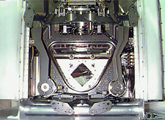
(HRC)
The primary components of the (HRC) are two Micro-Channel Plates (MCP). They each consist of a 10-cm (4-inch) square cluster of 69 million tiny lead-oxide glass tubes that are about 10 micrometers in diameter (1/8 the thickness of a human hair) and 1.2 millimeters (1/20 an inch) long. The tubes have a special coating that causes electrons to be released when the tubes are struck by X-rays. These electrons are accelerated down the tube by a high voltage, releasing more electrons as they bounce off the sides of the tube. By the time they leave the end of the tube, they have created a cloud of thirty million electrons. A crossed grid of wires detects this electronic signal and allows the position of the original X-ray to be determined with high precision. With this information astronomers can construct a finely detailed map of a cosmic X-ray source. The (HRC) is especially useful for imaging hot matter in remnants of exploded stars, and in distant galaxies and clusters of galaxies, and for identifying very faint sources.
Advanced CCD Imaging Spectrometer (ACIS)
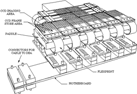
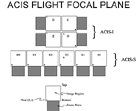
The Chandra Advanced CCD Imaging Spectrometer (ACIS) is one of two focal plane instruments. As the name suggests, this instrument is an array of charged coupled devices (CCD's), which are sophisticated versions of the crude CCD's used in camcorders. This instrument is especially useful because it can make X-ray images, and at the same time, measure the energy of each incoming X-ray. Thus scientists can make pictures of objects using only X-rays produced by a single chemical element, and so compare (for example) the appearance of a supernova remnant in light produced by oxygen ions to that of neon or iron ions. It is the instrument of choice for studying temperature variations across X-ray sources such as vast clouds of hot gas in intergalactic space, or chemical variations across clouds left by supernova explosions.
The High Resolution Spectrometers - HETGS and LETGS
There are two instruments aboard Chandra dedicated to high resolution spectroscopy: the High Energy Transmission Grating Spectrometer (HETGS) and the Low Energy Transmission Grating Spectrometer (LETGS). Each spectrometer is activated by swinging an assembly into position behind the mirrors. The assembly holds hundreds of gold transmission gratings: when in place behind the mirrors, the gratings intercept the X-rays reflected from the mirrors.
Transmission Gratings
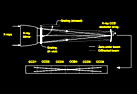
These gratings diffract the intercepted X-rays, changing their direction by amounts that depend sensitively on the X-ray energy, much like a prism separates light into its component colors. One of the focal plane cameras, either HRC or ACIS, detects the location of the diffracted X-ray, enabling a precise determination of its energy. (A grating is able to diffract because it has a regularly spaced pattern. For example, music CDs act as a type of grating: the grooves diffract, so that when light falls on the shiny side of the CD, a rainbow effect is seen. As the CD is tilted through different angles, different colors come into view.)
The gratings exploit Chandra's sharp mirror focus and matching detector resolution to produce high resolution X-ray spectroscopy. Since the grating spectrometers can measure energy to an accuracy of up to one part in a thousand, they are used in the study of detailed energy spectra, distinguishing individual X-ray lines. This enables the temperature, ionization and chemical composition to be explored.
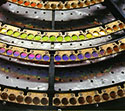
LETG
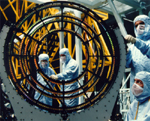
The LETG grating is a freestanding gold grating made of fine wires or bars with a regular spacing, or period , of 1µm. The fine gold wires are held by two different support structures, a linear grid with 25.4µm and a coarse triangular mesh with 2 mm spacing. The gratings are mounted onto a toroidal ring structure matched to the Chandra mirrors. The LETG gratings are designed to cover an energy range of 0.08 to 2 keV. However, their diffraction can also be seen in visible light, which is beautifully shown in the picture above right.
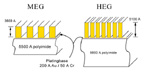
Grating Cross Section
The HETG gratings have a much finer period, 0.2µm or 2000Å for the high-energy gratings, and 0.4µm or 4000Å, for the medium energy gratings. In order to distinguish between them, the two types of gratings are oriented at slightly different angles, so that the X-rays are diffracted in an "X" pattern at the focal plane. Since the size of the gold grating bars is smaller that a wavelength of visible light, special fabrication techniques are required to make them. The gratings take advantage of the fact that the gold bars are partially transparent to X-rays, so that the diffraction is more efficient, and more X-rays are captured in the high resolution spectrum. The HETG gratings are designed to cover an energy range of 0.4 to 10 keV.
Operations
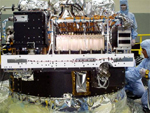
SIM
The focal plane instruments are mounted on the Science Instrument Module (SIM). The SIM contains mechanisms to move the science instruments in and out of the focal plane, insulation for thermal control, and electronics to control the operation of the science instruments via the communication, command and data management systems of the spacecraft.
The science instruments are controlled by commands transmitted from the Operations Control Center in Cambridge, Massachusetts. A preplanned sequence of observations is uplinked to Chandra and stored in the onboard computer for later execution.
Data collected by observations with Chandra are stored on a recorder for later transmission to the ground every eight hours during regularly scheduled Deep Space network contacts. The data is then transmitted to the Jet Propulsion Laboratory and then to Operations Control at the Chandra X-ray Center (CXC) in Cambridge, MA for processing and analysis by scientists.




Revised: July 02, 2019