
General
Back To School: Three Simple Ways to Share the Universe With Your Child
Parents can play an important part in helping their child explore the world around them. Space might seem far out there, but it can ignite your child's imagination — and can cause them to zip around your living room pretending to be a rocket among the outer planets.
We have developed a lot of educational Chandra activities and products to do just that (ignite your child's imagination that is, not send them to the outer planets!). Here are three easy things to try with your young child (ages 5-8) to bring a little bit of Chandra and the rest of the Universe right to them.

TEN YEARS AFTER THE FIRST
Ten years ago tomorrow (August 26th), the official First Light image from Chandra was released to the world. The image was of the famous supernova remnant Cassiopeia A, taken less than a month after Chandra was deployed by the Space Shuttle Columbia.
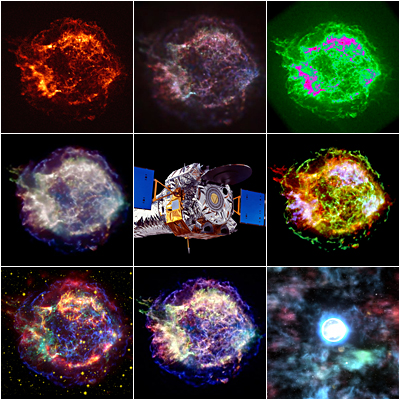
Snapshots of Cassiopeia A
Ten Years Later
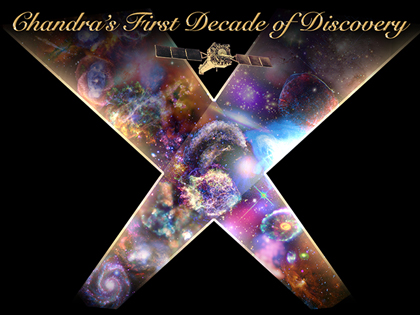
It's been ten years since Chandra was launched. A decade is a long time for a spacecraft, or any other complex machine, to operate without maintenance. Hubble has been up 18 years (launch 1991), but it has had regular maintenance with five Space Shuttle crews putting in new instruments and replacing worn out old parts. Chandra, on the other hand, was deliberately placed where the Shuttle couldn't service it. So Chandra's not doing badly considering there will be no 200-million-mile/10-year tune up!
Cool Stories From The Hot Universe
The Chandra EPO group has put together the following list of cool Chandra stories, realizing that if too many people agree that they're cool, they may cease to be cool. The list is not in any order of priority because we suspect that would be uncool.
Skipping Over The One Small Step
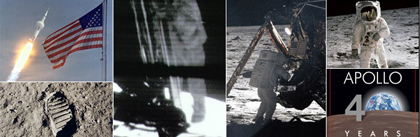
This week marks the 40th anniversary of Apollo 11's historic landing on the Moon, when human beings stepped on our favorite (and only) natural satellite for the first time. This will be in the news all week, so we thought it would be a good time to revisit Chandra's contribution to studying the Moon.
A Different Kind of Peer Pressure
Last month, over one hundred astronomers met for several days of marathon sessions in a Boston-area hotel. The purpose of this intense gathering, which takes a lot of work for the Chandra X-ray Center to organize, was to decide what Chandra will observe in the upcoming year. This process, called "peer review," is the engine that drives the science that Chandra discovers.
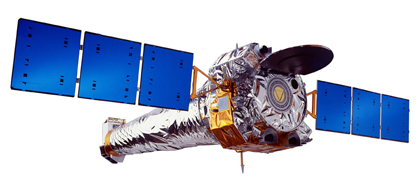
Like many space-based telescopes, Chandra is a tax-funded observatory (through NASA). And so, any scientist around the world is allowed to propose for observing time. In these proposals, the scientists have to explain and justify why it's worth the telescope's busy schedule to look at a particular target.
Seamless Astronomy and Remote Collaborations
Pepi Fabbiano is a senior astrophysicist at the Smtihsonian Astrophysical Observatory. In addition to her duties with Chandra and her research into galaxies, black holes, and other aspects of the high-energy Universe, she also actively involved in helping bringing astronomy and its tools into the 21st century.
I am just back from the spring meeting of the International Virtual Observatory Alliance (IVOA). The IVOA is an international collaboration of astronomers and computer scientists aimed at connecting via the internet archives of astronomical data world-wide. These are observations of the sky both from the ground and space and include X-ray data Chandra together with radio, optical, infrared and ultraviolet observations. The purpose of the IVOA is to develop standards so that anyone can retrieve data from the participant archives, publish their own observations to the world, and make the data "play together" to discover new aspects of the universe.
The Numbers are Just a Tool
Martin Elvis is a senior astrophysicist at the Smithsonian Astrophysical Observatory. When not getting bumped up to business class, he studies quasars and other fascinating phenomena in the Universe with Chandra and other telescopes.
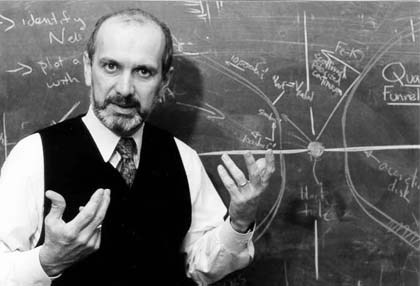
Copyright: Smithsonian Institution, from SI Research Reports
A GPS System for Cosmic Images
Imagine getting a picture of some random patch of the Earth. This picture has some features on it - maybe a mountain or a river or even a city - but from the altitude it was taken, you can't be exactly sure what's what. And then imagine if someone asked you to place it exactly where it should lie on the Earth. Really hard, right?
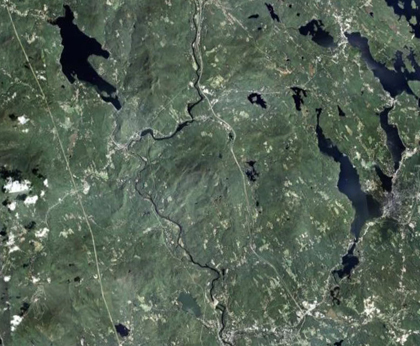
It's New Hampshire - USA
Well, of course, it gets a lot easier if someone were to give you the exact longitude and latitude. While this seems like an obvious thing to do, it's not so simple for astronomical images. When astronomers create their images for scientific purposes, these images retain certain coordinate information - like longitude and latitude - but for space. Unfortunately, when these images get processed further to make them attractive for the public, this information gets stripped out. In other words, we're back to having no clue where this image matches up with anything else.
Carnival of Space
Many of this week's blogs focused on that little-known telescope that's being invaded by a spaceship. In case you missed it, the telescope is called "Hubble" and the spaceship is our Space Shuttle Atlantis. Naturally, the astro-blogosphere took notice. In his "Dynamic of Cats" blog, Steinn Sigurdsson talks about the last pretty picture to come out of that workhorse instrument with the stubborn screw -- Wide Field/Planetary Camera 2.
