
Normal Galaxies & Starburst Galaxies
A Hidden Population of Cosmic Beacons: Discovering Hypersoft X-ray Sources with Chandra

Mustafa Muhibullah (Credit: Mustafa Muhibullah)
We welcome Mustafa Muhibullah as a guest blogger. He is the first author of a Nature Astronomy paper that is the subject of our latest press release. Mustafa is a Ph.D. candidate in Physics & Astronomy at the University of Alabama, working with Prof. Jimmy Irwin since Fall 2021. His research focuses on high-energy astrophysics, particularly faint and compact X-ray sources and galaxy clusters, using NASA’s Chandra X-ray Observatory. He earned his M.S. in Physics from the University of Missouri–Kansas City in 2021 and his B.S. in Mechanical Engineering from Rajshahi University of Engineering & Technology, Bangladesh.
The “Unobserved” Window of the Universe
Modern astronomy explores the Universe across nearly the entire electromagnetic spectrum, from radio waves to X-rays. Yet one important window remains largely hidden: the extreme-ultraviolet (EUV), a narrow but energetic region between ultraviolet light and low-energy X-rays. For observers in the Milky Way, EUV radiation from distant sources is almost completely blocked by the cool, neutral hydrogen and helium that fill our Galaxy and readily absorbs these photons before they can reach our telescopes.
We know that powerful EUV emitters exist. For example, astronomers know that hot, massive stars, the solar corona, and active galaxies can all produce substantial EUV emission. Fortunately, they also radiate at other wavelengths, allowing astronomers to detect and study them even when their EUV light is absorbed.
Zombie Disks May Solve a Cosmic Mystery
The cosmos is full of surprises. When new classes of objects are discovered they can turn out to have more than one explanation. Some supernova explosions, for example, are triggered by the dramatic collapse of massive stars, while others involve the thermonuclear explosions of white dwarf stars. These two types of stars are remarkably different in size, mass, composition and density, but both can produce explosions that outshine entire galaxies. Another example is gamma ray bursts, which involve either the collapse of massive stars or the merger of two neutron stars.
The origin of the newly-discovered class of hypersoft X-ray sources is unknown, but similar diversity may apply. One leading idea is that many of them involve matter falling onto the surfaces of white dwarfs. Once the white dwarfs reach a sufficient mass they may explode as Type Ia supernovas, addressing the mystery of what triggers these spectacular explosions. In other words, some of these hypersoft X-ray sources may represent the build up to Type Ias — a very important category of supernovas that lets astronomers measure the accelerating expansion of the Universe. However, this explanation struggles to explain the brightest of the hypersoft X-ray sources.
Galactic Gems Glisten in New Gallery From NASA's Chandra
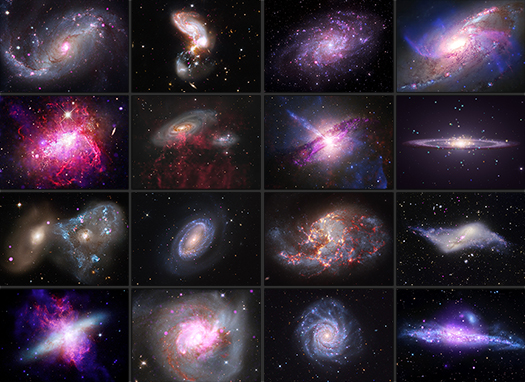
Galaxies are like cosmic gems, each with characteristics including size and shape that make them distinct. A new gallery released today from NASA’s Chandra X-ray Observatory and other telescopes displays a collection of galactic images that showcase this variety.
Astronomers put galaxies into three main categories: spirals like our own Milky Way with arms emanating from their cores, ellipticals that are older and likely the results of mergers, and irregulars that can encompass a wide range of galactic phenomena.
Just as gems reveal the history of Earth through how they were forged over billions of years, these galactic gems are a way to study Earth’s place in our home galaxy of the Milky Way. By looking outward to other galaxies, we learn more about our own – including clues to its past and future.
NASA's Chandra Finds Unexpected Fireworks in Aftermath of Stellar Explosions
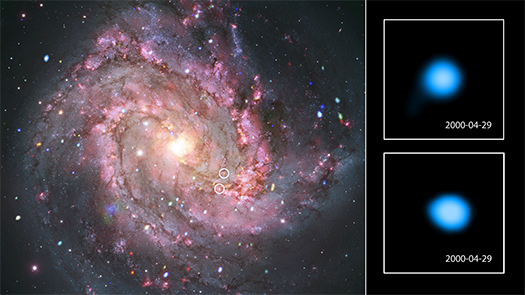
M83
More images, videos, and information
Credit: X-ray: NASA/CXC/SAO; Optical: NASA/ESA/AURA/STScI, Hubble Heritage Team, W. Blair (STScI/Johns Hopkins University) and R. O'Connell (University of Virginia); Image Processing: NASA/CXC/SAO/A. Jubett, L. Frattare and P. Edmonds
This graphic shows two of the X-ray sources in a nearby galaxy that are changing their brightness in surprising ways as described in our latest press release. By analyzing data from NASA’s Chandra X-ray Observatory that span over 14 years, researchers found over 20 previously identified supernova remnants — remains from stars that exploded — that vary unexpectedly in X-ray brightness in Messier 83 (M83). These represent roughly half of the X-ray sources associated with supernova remnants in their sample in M83.
The panel on the left contains a composite image of M83 with X-rays from Chandra (red, green, and blue) and optical light data from NASA’s Hubble Space Telescope (red, green, and blue). The two varying Chandra sources are circled in the composite image and close-up timelapse images of these sources are shown in the panels on the right.
Fall Collection: Before Fall Leaves, See Seasonal Offerings from NASA's Chandra
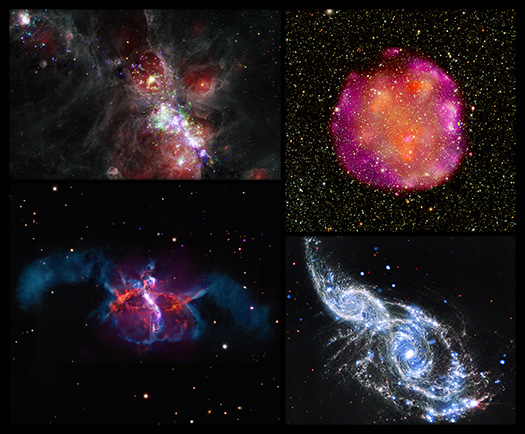
Before fall gives way to winter in the northern hemisphere, NASA’s Chandra X-ray Observatory has several images that celebrate autumn and its many delights to share. In spirit of the season, this collection gathers Chandra data with those from its telescopic family including NASA’s James Webb, Hubble, and Spitzer Space Telescopes, plus others in space and on the ground.
Black Holes Can Cook for Themselves
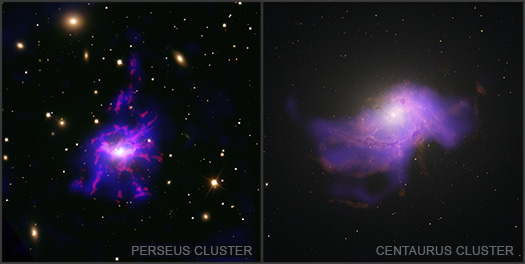
30 The Perseus & Centaurus Galaxy Clusters
Credit: Perseus: X-ray: NASA/CXC/SAO/V. Olivares et al.; Optical/IR: DSS; H-alpha: CFHT/SITELLE; Image Processing: NASA/CXC/SAO/N. Wolk; Centaurus: X-ray: NASA/CXC/SAO/V. Olivaresi et al.; Optical/IR: NASA/ESA/STScI; H-alpha: ESO/VLT/MUSE; Image Processing: NASA/CXC/SAO/N. Wolk
Astronomers have taken a crucial step in showing that the most massive black holes in the universe can create their own meals. Data from NASA’s Chandra X-ray Observatory and the Very Large Telescope (VLT) provide new evidence that outbursts from black holes can help cool down gas to feed themselves.
This study was based on observations of seven clusters of galaxies. The centers of galaxy clusters contain the universe’s most massive galaxies, which harbor huge black holes with masses ranging from millions to tens of billions of times that of the Sun. Jets from these black holes are driven by the black holes feasting on gas.
NASA's Chandra Finds Galaxy Cluster That Crosses the Streams
Zwicky 8338
Credit: X-ray: NASA/CXC/Xiamen Univ./C. Ge; Optical: DESI collaboration; Image Processing: NASA/CXC/SAO/N. Wolk
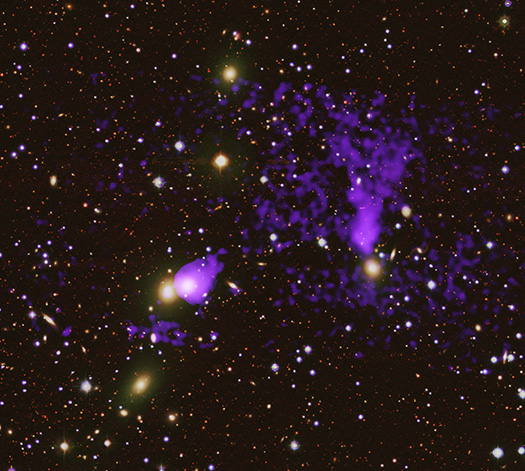
Astronomers using NASA’s Chandra X-ray Observatory have found a galaxy cluster has two streams of superheated gas crossing one another. This result shows that crossing the streams may lead to the creation of new structure.
Researchers have discovered an enormous, comet-like tail of hot gas — spanning over 1.6 million light-years long — trailing behind a galaxy within the galaxy cluster called Zwicky 8338 (Z8338 for short). This tail, spawned as the galaxy had some of its gas stripped off by the hot gas it is hurtling through, has split into two streams.
This is the second pair of tails trailing behind a galaxy in this system. Previously, astronomers discovered a shorter pair of tails from a different galaxy near this latest one. This newer and longer set of tails was only seen because of a deeper observation with Chandra that revealed the fainter X-rays.
Chandra Teams Up Again With Astrophotographers
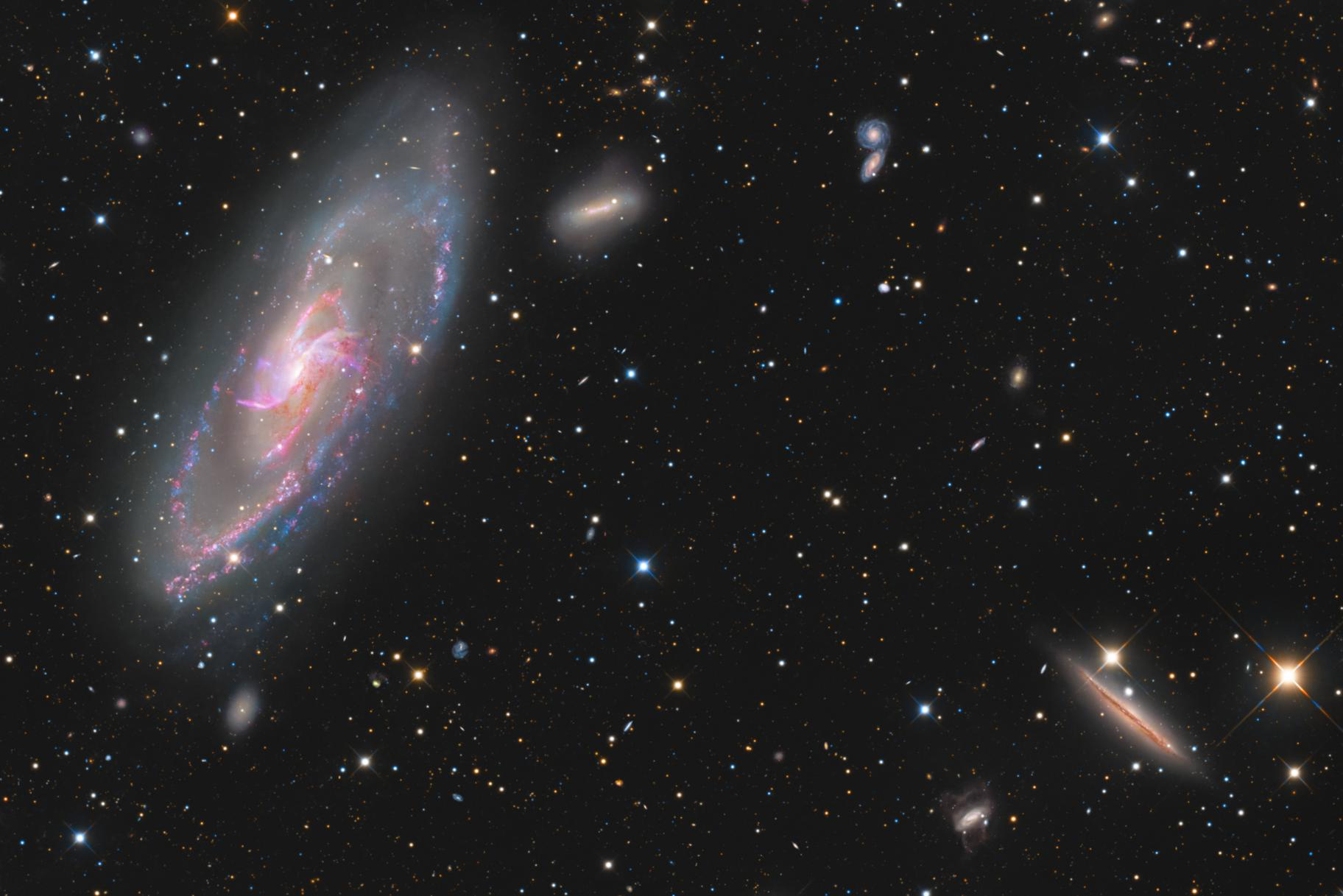
Messier 106 (M106), also known as NGC 4258, is a spiral galaxy – like our own Milky Way -- located in the constellation Canes Venatici. It lies at a distance of roughly 23 million light-years and spans some 135,000 light-years in diameter.
This galaxy is famous, however, for something that our Galaxy doesn’t have – two extra spiral arms that glow in X-ray, optical, and radio light. These features, called anomalous arms, are not aligned with the plane of the galaxy, but instead intersect with it. The X-ray image from Chandra reveals huge bubbles of hot gas above and below the plane of the galaxy. These bubbles indicate that much of the gas that was originally in the disk of the galaxy has been heated to millions of degrees and ejected into the outer regions by the jets from a supermassive black hole at the galaxy’s core.
Credit: Optical: Deep Sky Collective; Chandra X-ray (purple): NASA/CXC/SAO;
VLA Radio (yellow): NSF/NRAO/VLA; Spitzer IR (Red): NASA/JPL-Caltech
It's not only space-based X-ray telescopes like Chandra, however, that have looked at M106. Excellent work has been done from the ground including by amateur astrophotographers including a group called the Deep Sky Collective (DSC). The DSC, founded by Tim Schaeffer in 2023, aims to use the group’s telescopes in a concerted way to explore some of the faintest and most difficult target in the sky in great detail.
New NASA Sonifications Listen to the Universe's Past
Your browser does not support the video tag.
Cassiopeia A Sonification
Credit: X-ray: NASA/CXC/SAO; Optical: NASA/ESA/STScI; IR: NASA/ESA/CSA/STScI/Milisavljevic et al., NASA/JPL/CalTech; Image Processing: NASA/CXC/SAO/J. Schmidt and K. Arcand; Sonification: NASA/CXC/SAO/K.Arcand, SYSTEM Sounds (M. Russo, A. Santaguida)
A quarter of a century ago, NASA released the “first light” images from the agency’s Chandra X-ray Observatory. This introduction to the world of Chandra’s high-resolution X-ray imaging capabilities included an unprecedented view of Cassiopeia A, the remains of an exploded star located about 11,000 light-years from Earth. Over the years, Chandra’s views of Cassiopeia A have become some of the telescope’s best-known images.
To mark the anniversary of this milestone, new sonifications of three images — including Cassiopeia A (Cas A) — are being released. Sonification is a process that translates astronomical data into sound, similar to how digital data are more routinely turned into images. This translation process preserves the science of the data from its original digital state but provides an alternative pathway to experiencing the data.
Astronomers Find Spark of Star Birth Across Billions of Years
Brightest Cluster Galaxies Survey
Credit: X-ray: NASA/CXC/MIT/M. Calzadilla el al.; Optical: NASA/ESA/STScI;
Image Processing: NASA/CXC/SAO/N. Wolk & J. Major
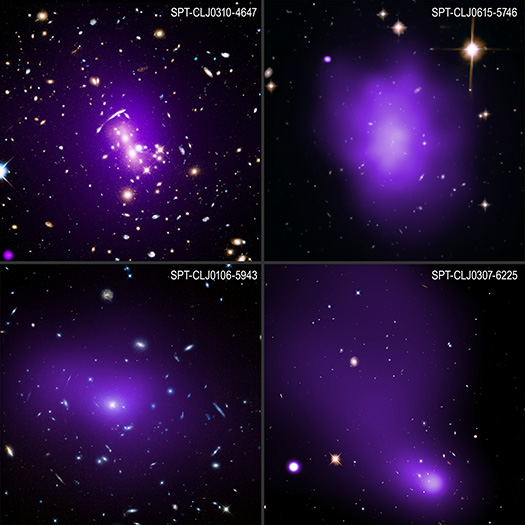
These four images represent a sample of galaxy clusters that are part of the largest and most complete study to learn what triggers stars to form in the universe’s biggest galaxies, as described in our latest press release. This research, made using NASA’s Chandra X-ray Observatory and other telescopes, showed that the conditions for stellar conception in these exceptionally massive galaxies have not changed over the last ten billion years.
Galaxy clusters are the largest objects in the universe held together by gravity and contain huge amounts of hot gas seen in X-rays. This hot gas weighs several times the total mass of all the stars in all the hundreds of galaxies typically found in galaxy clusters. In the four galaxy cluster images in this graphic, X-rays from hot gas detected by Chandra are in purple and optical data from NASA’s Hubble Space Telescope, mostly showing galaxies in the clusters, are yellow and cyan.