Jupiter Sonification
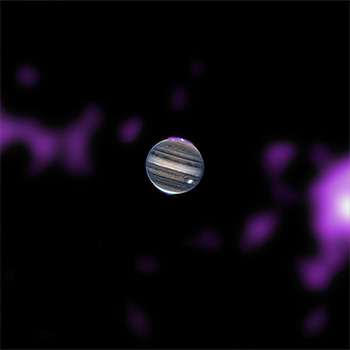
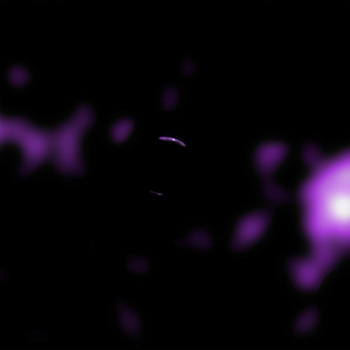
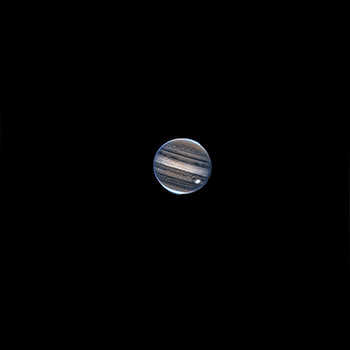
In this image, the amount of diffuse X-rays from a donut-shaped ring of energetic particles around Jupiter, seen on the left and right side of the planet, has been enhanced compared to the amount of X-rays from the planet's auroras, seen at the poles. As the scan moves left to right, it encounters X-rays that bracket the planet on either side, and this plays as woodwind sounds. As we pass over the planet itself, seen in an infrared image from NASA’s Hubble Space Telescope, the sounds become fuller as the infrared data is represented by other instruments. Since Jupiter is tilted slightly, the pitch descends as the scan passes over the bright band near the equator and through the Great Red Spot. On the other side, more X-ray data from Chandra flanks the planet and can be heard as gusty wind sounds at the end.
Access more information & file formats on this sonification
<< Back to Explore Sounds
The Chandra sonifications were led by the Chandra X-ray Center (CXC), with input from NASA's Universe of Learning. The sustained collaboration was driven by visualization scientist Dr. Kimberly Arcand (CXC), astrophysicist Dr. Matt Russo and musician Andrew Santaguida (both of the SYSTEM Sounds project). For other sonifications, please see their linked pages.