
Normal Stars & Star Clusters
Chandra Finds Evidence for Stellar Cannibalism
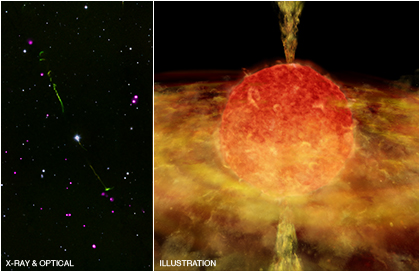
The composite image on the left shows X-ray and optical data for BP Piscium (BP Psc), a more evolved version of our Sun about 1,000 light years from Earth. Chandra X-ray Observatory data are colored in purple, and optical data from the 3-meter Shane telescope at Lick Observatory are shown in orange, green and blue. BP Psc is surrounded by a dusty and gaseous disk and has a pair of jets several light years long blasting out of the system. A close-up view is shown by the artist's impression on the right. For clarity a narrow jet is shown, but the actual jet is probably much wider, extending across the inner regions of the disk. Because of the dusty disk, the star's surface is obscured in optical and near-infrared light. Therefore, the Chandra observation is the first detection of this star in any wavelength.
The Heart of a Rose
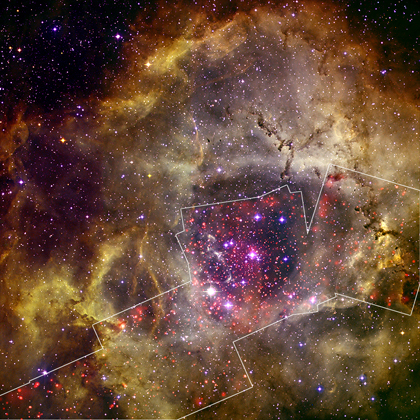
This composite image shows the Rosette star formation region, located about 5,000 light years from Earth. Data from the Chandra X-ray Observatory are colored red and outlined by a white line. The X-rays reveal hundreds of young stars in the central cluster and fainter clusters on either side. Optical data from the Digitized Sky Survey and the Kitt Peak National Observatory (purple, orange, green and blue) show large areas of gas and dust, including giant pillars that remain behind after intense radiation from massive stars has eroded the more diffuse gas.
A Close-up View of Codependent Stellar Living
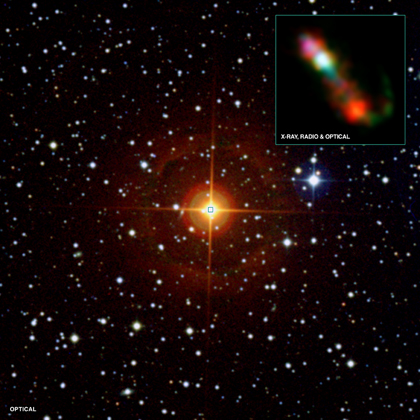
This image shows the symbiotic system known as CH Cyg, located only about 800 light years from Earth. The large image shows an optical view of CH Cyg, using the Digitized Sky Survey, and the inset shows a composite image containing Chandra X-ray data in red, optical data from the Hubble Space Telescope (HST) in green, and radio data from the Very Large Array (VLA) in blue.
Cepheus B: Trigger-Happy Star Formation

This composite image of X-rays from Chandra (violet) and infrared data from Spitzer (red, green, and blue) reveals a beautiful scene of star formation within our Galaxy. There are hundreds of very young stars inside and around the cloud -- ranging from a few millions years old outside the cloud to less than a million in the interior -- making it an important testing ground for star formation. By combining the data from these two observatories, researchers have shown that radiation from massive stars may trigger the formation of many more stars than previously thought.
Doing More with More
Back in 2002, we released a colorful image of the star-forming region known as 30 Doradus (also called the Tarantula Nebula.) At the time, we thought it was a beautiful image - and it was - of this pocket of intense stellar birth and death in the neighboring Large Magellanic Cloud.
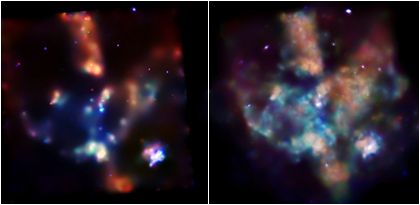
Chandra's 30 Doradus from 2002 (left) and 2008 (right)