Unexpected
A Hidden Population of Cosmic Beacons: Discovering Hypersoft X-ray Sources with Chandra

Mustafa Muhibullah (Credit: Mustafa Muhibullah)
We welcome Mustafa Muhibullah as a guest blogger. He is the first author of a Nature Astronomy paper that is the subject of our latest press release. Mustafa is a Ph.D. candidate in Physics & Astronomy at the University of Alabama, working with Prof. Jimmy Irwin since Fall 2021. His research focuses on high-energy astrophysics, particularly faint and compact X-ray sources and galaxy clusters, using NASA’s Chandra X-ray Observatory. He earned his M.S. in Physics from the University of Missouri–Kansas City in 2021 and his B.S. in Mechanical Engineering from Rajshahi University of Engineering & Technology, Bangladesh.
The “Unobserved” Window of the Universe
Modern astronomy explores the Universe across nearly the entire electromagnetic spectrum, from radio waves to X-rays. Yet one important window remains largely hidden: the extreme-ultraviolet (EUV), a narrow but energetic region between ultraviolet light and low-energy X-rays. For observers in the Milky Way, EUV radiation from distant sources is almost completely blocked by the cool, neutral hydrogen and helium that fill our Galaxy and readily absorbs these photons before they can reach our telescopes.
We know that powerful EUV emitters exist. For example, astronomers know that hot, massive stars, the solar corona, and active galaxies can all produce substantial EUV emission. Fortunately, they also radiate at other wavelengths, allowing astronomers to detect and study them even when their EUV light is absorbed.
Zombie Disks May Solve a Cosmic Mystery
The cosmos is full of surprises. When new classes of objects are discovered they can turn out to have more than one explanation. Some supernova explosions, for example, are triggered by the dramatic collapse of massive stars, while others involve the thermonuclear explosions of white dwarf stars. These two types of stars are remarkably different in size, mass, composition and density, but both can produce explosions that outshine entire galaxies. Another example is gamma ray bursts, which involve either the collapse of massive stars or the merger of two neutron stars.
The origin of the newly-discovered class of hypersoft X-ray sources is unknown, but similar diversity may apply. One leading idea is that many of them involve matter falling onto the surfaces of white dwarfs. Once the white dwarfs reach a sufficient mass they may explode as Type Ia supernovas, addressing the mystery of what triggers these spectacular explosions. In other words, some of these hypersoft X-ray sources may represent the build up to Type Ias — a very important category of supernovas that lets astronomers measure the accelerating expansion of the Universe. However, this explanation struggles to explain the brightest of the hypersoft X-ray sources.
The Unexpected: Supernova Remnants and Neutron Stars
What has Chandra found (or not found) during the course of its mission in the important area of exploded stars and what they leave behind? Find out in this post in "The Unexpected" series.
Expected and Detected:

As anticipated, high-resolution X-ray images have provided new insight into the supernova process, the effect supernova shock waves have on the surrounding interstellar gas, the acceleration of particles by rotating neutron stars, and enabled the discovery of many stellar-mass black holes. More information:
https://www.chandra.harvard.edu/photo/2009/crab/
The Unexpected: Normal Stars
Here's our next installation in our occasional series on the Chandra blog called "The Unexpected." These posts will take a look at some of the biggest surprises (and expected discoveries) made by Chandra so far in its mission. Today's topic is "normal stars," which is what astronomers call stars that are similar to our Sun.
Expected and Detected:
X-ray emission from the outer atmospheres, or coronas, of stars of almost every type: young and old, large and small.
The Unexpected: The Solar System
Looking back on the more than twelve years of science from NASA’s Chandra X-ray Observatory and trying to predict what it will find in the future, one thing is certain: we can expect the unexpected.
This blog series will look at both some of the anticipated findings from the past dozen or so years, plus some of the unexpected results so far from the Chandra mission. Today, we look at discoveries involving our Solar System.
Expected and Detected:
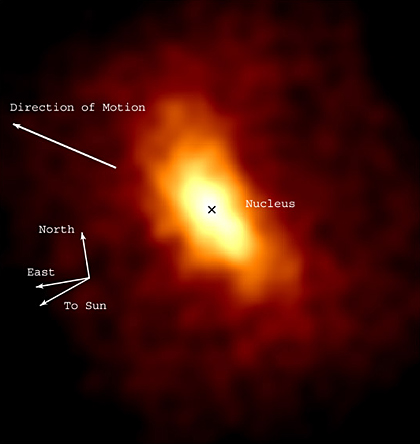
X-ray emission was detected from the atmospheres of planets and comets. The X-rays are produced when solar X-rays and high-speed particles flowing away from the Sun hit these atmospheres. The observed X-radiation provides information on the outer atmospheres of these objects that is difficult to obtain with other telescopes.