Images by Date
Images by Category
Solar System
Stars
Exoplanets
White Dwarfs
Supernovas
Neutron Stars
Black Holes
Milky Way Galaxy
Normal Galaxies
Quasars
Galaxy Clusters
Cosmology/Deep Field
Miscellaneous
Images by Interest
Space Scoop for Kids
Multiwavelength
Sky Map
Constellations
Photo Blog
Top Rated Images
Image Handouts
Desktops
Fits Files
Visual descriptions
Image Tutorials
Photo Album Tutorial
False Color
Cosmic Distance
Look-Back Time
Scale & Distance
Angular Measurement
Images & Processing
AVM/Metadata
Image Use Policy
Web Shortcuts
Chandra Blog
RSS Feed
Image Use Policy
Questions & Answers
Glossary of Terms
Galaxy Gallery: Galactic Gems Glisten in New Gallery From NASA's Chandra
Galaxy Gallery
Visual Description:

  • A new gallery of galaxies, each containing data from NASA’s Chandra X-ray Observatory, has been released.

  • Astronomers put galaxies into three main categories: spirals, ellipticals, and irregulars.

  • Each type plays a role in the story of the universe and is represented in this new collection.

  • In this gallery, Chandra data have been combined with those from NASA's Webb, Hubble, IXPE, Swift, NuSTAR, and more.

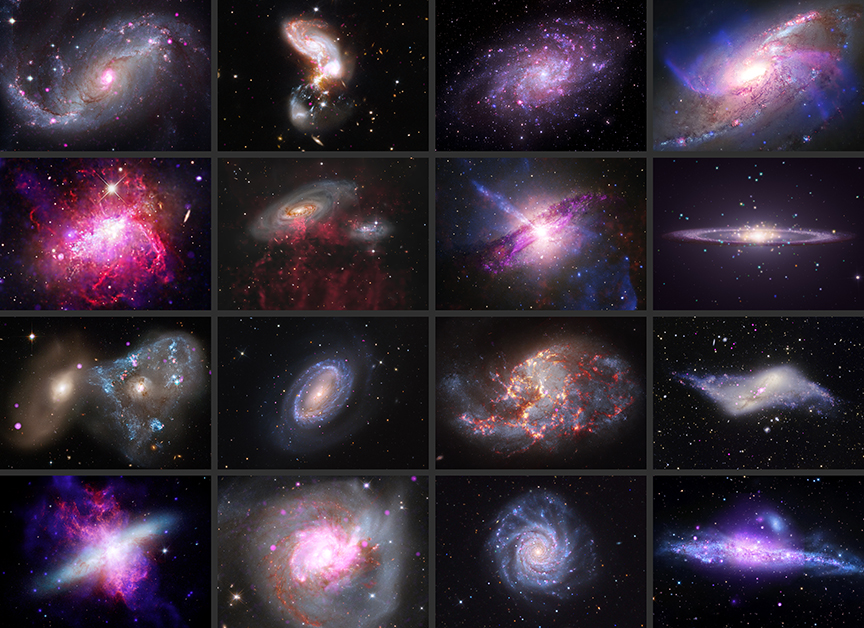
Galaxies are like cosmic gems, each with characteristics including size and shape that make them distinct. A new gallery released today from NASA’s Chandra X-ray Observatory and other telescopes displays a collection of galactic images that showcase this variety.

Astronomers put galaxies into three main categories: spirals like our own Milky Way with arms emanating from their cores, ellipticals that are older and likely the results of mergers, and irregulars that can encompass a wide range of galactic phenomena.

Just as gems reveal the history of Earth through how they were forged over billions of years, these galactic gems are a way to study Earth’s place in our home galaxy of the Milky Way. By looking outward to other galaxies, we learn more about our own – including clues to its past and future.

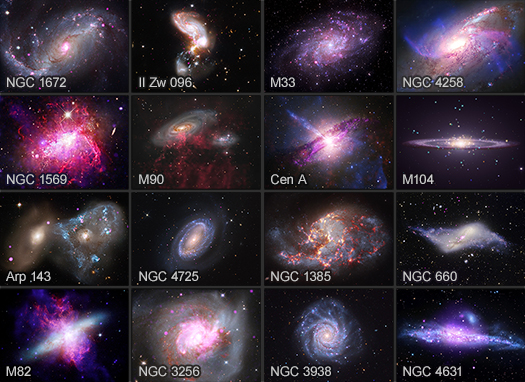
A labeled version of the main image showing sixteen images in four rows and four columns. First row labels are: NGC 1672, II Zw 096, M33, and NGC 4258. Second row labels are: NGC 1569, M90, Centaurus A, and M104. Third row labels are: Arp 143, NGC 4725, NGC 1385, and NGC 660. Fourth row labels are: M82, NGC 3256, NGC 3938, and NGC 4631.
Galaxy Gallery, labeled. Credit: NASA/CXC/SAO

There are 16 new images in this galactic gallery. Each one contains X-ray data from Chandra that has been collected across Chandra’s decades in space. This high-energy data has been combined with data from telescopes such as NASA’s James Webb and Hubble Space Telescopes, IXPE (Imaging X-ray Polarimetry Explorer), Neil Gehrels Swift Observatory, NuSTAR (Nuclear Spectroscopic Telescope Array), and others both on the ground and in space.

X-rays are critical for the study of galaxies, revealing unique and important information about these cosmic building blocks. For example, Chandra exposes gas that has been superheated to millions of degrees by winds from massive stars, the outflows from supermassive black holes, and the debris from exploded stars. These are key sources of elements in our bodies, in the air we breathe, and the planet we live on. Chandra also sees some of the hottest and most energetic galactic phenomena in the universe, forming a more complete picture of how galaxies live, interact, and evolve when combined with data from other types of light and telescopes

Spiral and star-forming engines
Face-on spiral galaxies like Messier 33 and NGC 3938 offer unobstructed views of places where energetic pairs of stars and cosmic explosions live along spiral arms. Barred spirals like NGC 1672 and NGC 1385 show how central bar-shaped collections of stars, gas, and dust funnel fuel inward to ignite bursts of star formation. NGC 4725 reveals how star formation can be triggered by a previous collision with another galaxy. Meanwhile, edge-on views of NGC 4631 (the Whale Galaxy) and the starburst Messier 82 (the Cigar Galaxy) showcase giant halos and superwinds of million-degree gas driven thousands of light-years into space by intense explosions of stars, enriching surrounding intergalactic space with vital elements.

Active galactic nuclei, black hole outflows
Powerful, growing black holes in the cores of their host galaxies, known as active galactic nuclei, send energy outward in outbursts and jets that impact entire galaxies. In Centaurus A, Chandra and IXPE data expose a high-energy particle jet blasting tens of thousands of light-years into space from its central engine. In Messier 106, jets from the supermassive black hole heat surrounding gas to create spiral arms that are different from those typically found in spiral galaxies. Meanwhile, the iconic Sombrero Galaxy (Messier 104) highlights a supermassive black hole embedded in a colossal stellar bulge, where Chandra’s X-rays map a diffuse halo of million-degree gas and hot stellar remnants surrounding its sweeping dust lanes.

Collisions, mergers, cosmic disruptions
The gallery also showcases galaxies undergoing extreme gravitational transformations. A direct impact in Arp 143 acts like a cosmic bullseye, creating an expanding ring galaxy and triggering waves of star birth. Violent mergers, such as NGC 3256 and the dust-shrouded starburst II Zw 096, reveal the kind of chaotic galaxy collisions that dominated the early universe and offer a preview of the Milky Way’s distant future merger with nearby galaxy Andromeda. NGC 1569 acts as a local laboratory for studying early universe starbursts, NGC 660 showcases a rare "polar ring" galaxy where a ring of stars orbits over its poles, and Messier 90 shows a spiral galaxy plowing through the Virgo Cluster, having its star-forming gas violently stripped away.

NASA's Marshall Space Flight Center manages the Chandra program. The Smithsonian Astrophysical Observatory's Chandra X-ray Center controls science operations from Cambridge, Massachusetts, and flight operations from Burlington, Massachusetts.


Visual Description:
Today's release features a gallery of galaxies, presented in a four-by-four grid.

Starting in the first row, at our upper left, is NGC 1672. At its center are two thick, spiraling, dark purple arms that bridge a brilliant white and neon pink core. Those bridging arms create a bar, which channels gas to the core, making NGC 1672 a barred spiral galaxy, like our own Milky Way. Longer, wispier arms also spiral out from the core, dotted with gleaming white and pink stars.

To the right of that image, second in the first row, is II Zw 096. In this system, two galaxies are merging at a furious rate. Near the top of the image is a spiral galaxy shape with thick arms in fiery oranges, whites, and reds. At the bottom of the image is a faint hazy bowl shape marbled with grainy white ribbons and hot pink specks. Where the two shapes collide, in the center of the frame, the galaxy appears utterly chaotic, like a firework photographed in the moment it explodes.

The third image in the first row features Messier 33, a spiral galaxy depicted in shades of pink and purple, shown almost face-on. The many arms of M33 are wispy and faint, dotted with scores of stars.

The final image in the first row features M106, a spiral galaxy in pinks and purples, shown at an angle, like a tipped dinner plate facing our upper left. From this vantage point, the spiraling arms look thick and frothy, resembling the top of a swirled strawberry milkshake. Clouds of royal blue appear to drift from the brilliant golden white core. These are superheated shock waves created by central black hole jets.

In the second row, the first image depicts NGC 1569. As a compact dwarf galaxy undergoing a violent burst of star formation, it resembles a tangle of glowing red yarn surrounding a white sparkler.

The second image in the second row features M90, a spiral galaxy positioned near our upper left of the frame. The arms of M90 are orange and red near the golden core but fade to cloudy and grey at the outer edges. Though large (even by galaxy standards!), here, M90 appears small, sitting at the edge of a red gas cloud in the Virgo cluster of galaxies.

The third image in the second row depicts Centaurus A, a giant elliptical galaxy with a powerful jet bursting from its core. Here, a neon purple ellipse tips from our upper right down to our lower left. A hazy violet jet of particles shoots out of the white core, aimed at our upper left.

The final image in the second row is M104, nicknamed the Sombrero Galaxy. Like the hat it's named after, M104 has a wide, flat, round brim, shown here as a hazy violet ring viewed nearly on its edge. At the center of the brim-like ring is a cluster of golden specks surrounding a golden core.

The first image in the third row features Arp 143, a merging pair of galaxies undergoing an extreme gravitational transformation. On our left side of the frame is a ghostly galaxy with a pale white core and faint outer ring. On our right is a pale white sphere-shaped galaxy surrounded by a grainy neon blue cloud, flecked with pink dots. The cloud has a funnel-like shape, pointing toward its ghostly neighbor. Astronomers believe that one galaxy passed through the other, igniting the firestorm of star creation found inside the blue cloud.

The second image in the third row depicts NGC 4725. This spiral galaxy has a single blue arm which makes two perfect rotations around its small white core. Tilted toward our upper left, the rather cute galaxy is flecked with tiny specks of light in white, yellow, pink, and blue.

In the third image of the third row, NGC 1385 resembles a tangle of red and golden orange veins, highlighted with hints of purple, marbling a grainy grey cloud. Though no clear core is apparent in this depiction, the cloud appears to glow, deep within its center.

The fourth and final image in the third row features NGC 660, a rare polar ring galaxy. Here, a tilted, wobbly ring encircles a short line that tilts from our upper right down to our lower left. The dark, muted ring and line are flecked with neon pink and surrounded by a pale violet cloud.

The first image in the fourth row, at our lower lefthand corner, depicts M82, an irregular galaxy undergoing intense star formation. Here, thick towers of turbulent fuchsia gas burst from the top and bottom of a pale blue galactic disk.

The second image in the fourth row depicts NGC 3256, a pair of overlapping spiral galaxies merging into a single massive system. Here, the merged galaxy is shown face-on, its thick pink, white, and orange spiraling arms dotted with large pink specks, amid a hazy grey cloud.

In the third image in the fourth row, a spiral galaxy known as NGC 3938 directly faces us. Packed with clearly defined, glowing, pale blue arms that spiral around a central golden core, and flecked with multicolored specks, NGC 3938 appears flawless and elegant.

The final image in the lower right of the four-by-four grid features NGC 4631. This spiral galaxy in blues and purples is viewed from the side, making it appear like a thick, tightly packed, line of stars surrounded by a faint blue haze.

When viewed as a whole, this gallery of composite images illustrates the remarkable variety of distinct shapes, systems, and patterns found in the ever-changing galaxies across our universe.


Fast Facts for NGC 1672:
Credit:  X-ray: NASA/CXC/SAO; Optical: NASA/ESA/STScI/Hubble Heritage Team; Infrared: NASA/ESA/CSA/STScI/J. Lee and T. Williams; Image Processing: NASA/CXC/SAO/L. Frattare, J. Major, K. Arcand
Release Date:  August 25, 2026
Scale:  Image is about 4.4 arcmin (75,000 light-years) across.
Category  Normal Galaxies & Starburst Galaxies
Coordinates (J2000):   RA: 04h 45m 42.1s | Dec: -59° 14' 56"
Constellation:  Dorado
Observation Date(s):  30 April 2006
Observation Time:  11 hours
Obs. IDs:  5932
Instrument:  ACIS
Color Code:  X-ray: purple; Optical: red, green, blue; Infrared: red, green, blue
Distance Estimate:  About 60 million light-years from Earth
IR
X-ray
distance arrow


Fast Facts for II Zw 096:
Credit:  X-ray: NASA/CXC/SAO; Optical: NASA/ESA/STScI; Infrared: NASA/ESA/CSA/STScI; Image Processing: NASA/CXC/SAO/L. Frattare and J. Major
Release Date:  August 25, 2026
Scale:  Image is about 1.5 arcmin (210,000 light-years) across.
Category  Normal Galaxies & Starburst Galaxies
Coordinates (J2000):   RA: 20h 57m 24.3s | Dec: +17° 7' 40.3"
Constellation:  Delphinus
Observation Date(s):  Sept 10, 2007
Observation Time:  4 hours 3 minutes
Obs. IDs:  7818
Instrument:  ACIS
Color Code:  X-ray: purple; Optical: red, green, blue; Infrared: red, green, blue
Distance Estimate:  About 490 million light-years from Earth
IR
Optical
X-ray
distance arrow


Fast Facts for M33:
Credit:  X-ray: NASA/CXC/SAO; Optical: ESO/VLT; UV: NASA/Swift; Image Processing: NASA/CXC/SAO/L. Frattare
Release Date:  August 25, 2026
Scale:  Image is about 50 arcmin (44,000 light-years) across.
Category  Normal Galaxies & Starburst Galaxies
Coordinates (J2000):   RA: 01h 33m 50s | Dec: +30° 39' 37"
Constellation:  Triangulum
Observation Date(s):  28 observations from January 2000 to November 2006
Observation Time:  401 hours (16 days 17 hours)
Obs. IDs:  786, 787, 1730, 3948, 6376-6389, 7170, 7171, 7196-7199, 7208, 7226, 7344, 7402
Instrument:  ACIS
Color Code:  X-ray: blue, purple; Optical: red, green, blue; Ultraviolet: red, green, blue
Distance Estimate:  About 3 million light-years from Earth
IR
X-ray
distance arrow


Fast Facts for NGC 4258:
Credit:  X-ray: NASA/CXC/SAO; Optical: NASA/ESA/STScI; Infrared: NASA/ESA/CSA/STScI; Image Processing: NASA/CXC/SAO/L. Frattare
Release Date:  August 25, 2026
Scale:  Image is about 6.6 arcmin (44,000 light-years) across.
Category  Normal Galaxies & Starburst Galaxies
Coordinates (J2000):   RA: 2h 19m 00s | Dec: +47° 18′ 00"
Constellation:  Canes Venatici
Observation Date(s):  Three pointings from April 17, 2000 to May 29, 2001
Observation Time:  12 hours
Obs. IDs:  350, 1618, 2340
Instrument:  ACIS
Color Code:  X-ray: blue; Optical: gold, blue; Infrared; red; Radio: purple
Distance Estimate:  About 23 million light-years from Earth
IR
Optical
X-ray
distance arrow


Fast Facts for NGC 1569:
Credit:   X-ray: (XMM):ESA/XMM-Newton, (Chandra): NASA/CXC/SAO; Optical: Univ.of Arizona/Mt Lemmon SkyCenter/Adam Block/Josep Drudis; Image Processing: NASA?CXC/SAO/L. Frattare
Release Date:  August 25, 2026
Scale:  Image is about 8 arcmin (26,000 light-years) across.
Category  Normal Galaxies & Starburst Galaxies
Coordinates (J2000):   RA: 04h 30m 49s | Dec: +64° 50′ 54"
Constellation:  Camelopardalis
Observation Date(s):  April 11, 2000 and Jan 10, 2004
Observation Time:  29 hours 40 minutes (1 day 5 hours 40 minutes)
Obs. IDs:  782, 4745
Instrument:  ACIS
Color Code:  X-ray: (XMM-Newton) blue, (Chandra) red, green, blue; Optical: red, green, blue
Distance Estimate:  About 11 million light-years from Earth
Optical
X-ray
distance arrow


Fast Facts for M90:
Credit:  X-ray: NASA/CXC/SAO; Optical: NASA/ESA/D. Thilker/J. Lee/PHANGS-HST Team; Full-field: Tim Martin; Image Processing: NASA/CXC/SAO/L. Frattare
Release Date:  August 25, 2026
Scale:  Image is about 2.8 arcmin (45,000 light-years) across.
Category  Normal Galaxies & Starburst Galaxies
Coordinates (J2000):   RA: 12h 36m 49.8s | Dec: +13° 9′ 48.9"
Constellation:  Virgo
Observation Date(s):  November 13, 2005
Observation Time:  10 hours 52 minutes
Obs. IDs:  5911
Instrument:  ACIS
Color Code:  X-ray: magenta; Optical: red, green, blue; Full-field Optical: red, green, blue
Distance Estimate:  About 55 million light-years from Earth
Optical
X-ray
distance arrow


Fast Facts for Centaurus A:
Credit:  X-ray: (Chandra) NASA/CXC/SAO, X-ray (IXPE): NASA/MSFC; Optical: ESO; Infrared: NASA/ESA/CSA/STScI; Image Processing: NASA/CXC/SAO/L. Frattare, K. Arcand, and J. Major
Release Date:  August 25, 2026
Scale:  Image is about 25 arcmin (87,000 light-years) across.

Category  Normal Galaxies & Starburst Galaxies
Coordinates (J2000):   RA: 13h 25m 27.62s | Dec: -43° 01′ 08.80"
Constellation:  Centaurus
Observation Date(s):  21 pointings between 05 Dec 1999 and 29 Aug 2012
Observation Time:  229 hours 57 minutes (9 days 13 hours 57 min)
Obs. IDs:  316, 962, 2978, 3965, 7797-7800, 8489, 8490, 10722-10726, 11846, 11847, 12155, 12156, 13303, 13304
Instrument:  ACIS
Color Code:  X-ray: (Chandra) blue, (IXPE) red, orange; Optical: yellow, Infrared: purple
Distance Estimate:  About 12 million light-years from Earth
IR
Optical
X-ray
distance arrow


Fast Facts for M104:
Credit:  X-ray: NASA/CXC/SAO; Optical:NASA/Hubble Heritage Team/AURA/STScI; Infrared: NASA/ESA/CSA/STScI; Image Processing: NASA/CXC/SAO/L. Frattare
Release Date:  August 25, 2026
Scale:  Image is about 8.4 arcmin (76,000 light-years) across.
Category  Normal Galaxies & Starburst Galaxies
Coordinates (J2000):   RA: 12h 39m 59.4s | Dec: -11° 37′ 23"
Constellation:  Virgo
Observation Date(s):  May 31st, 2001
Observation Time:  5 hours and 9 minutes
Obs. IDs:  1586
Instrument:  ACIS
Color Code:  X-ray: red, green, blue; Optical: red, green, blue; Infrared: red, green, blue
Distance Estimate:  About 31 million light-years from Earth
IR
Optical
X-ray
distance arrow


Fast Facts for Arp 143:
Credit:  X-ray: NASA/CXC/SAO; Optical: NASA/ESA/STScI/J. Dalcanton; Image Processing: NASA/CXC/SAO/L. Frattare
Release Date:  August 25, 2026
Scale:  Image is about 3.3 arcmin (180,000 light-years) across.
Category  Normal Galaxies & Starburst Galaxies
Coordinates (J2000):   RA: 7h 46m 54.7s | Dec: +39° 1′ 23.81"
Constellation:  Lynx
Observation Date(s):  December 10, 2012
Observation Time:  10 hours 50 minutes
Obs. IDs:  14906
Instrument:  ACIS
Color Code:  X-ray: purple; Optical: red, green, blue
Distance Estimate:  About 191 million light-years from Earth
Optical
X-ray
distance arrow


Fast Facts for NGC 4725:
Credit:  X-ray: NASA/CXC/SAO; Optical: NASA/ESA/STScI/NAOJ/R. Gendler; Image Processing: NASA/CXC/SAO/L. Frattare
Release Date:  August 25, 2026
Scale:  Image is about 12 arcmin (140,000 light-years) across.
Category  Normal Galaxies & Starburst Galaxies
Coordinates (J2000):   RA: 12h 50m 26.6s | Dec: +25° 30′ 02.7"
Constellation:  Coma Berenices
Observation Date(s):  May 9, 2016
Observation Time:  8 hours 11 minutes
Obs. IDs:  17461
Instrument:  ACIS
Color Code:  X-ray: magenta; Optical: red, green, blue
Distance Estimate:  About 41 million light-years from Earth
Optical
X-ray
distance arrow


Fast Facts for NGC 1385:
Credit:  X-ray: NASA/CXC/SAO; Optical: NASA/ESA/STScI; Infrared: NASA/ESA/CSA/STScI; Image Processing: NASA/CXC/SAO/L. Frattare
Release Date:  August 25, 2026
Scale:  Image is about 2.7 arcmin (23,000 light-years) across.
Category  Normal Galaxies & Starburst Galaxies
Coordinates (J2000):   RA: 3h 37m 28.33s | Dec: -24° 30′ 3.22"
Constellation:  Fornax
Observation Date(s):  December 6, 2018
Observation Time:  1 hour 24 minutes
Obs. IDs:  21473
Instrument:  ACIS
Color Code:  X-ray: magenta; Optical: red, green, blue; Infrared: red, green, blue
Distance Estimate:  About 30 million light-years from Earth
IR
Optical
X-ray
distance arrow


Fast Facts for NGC 660:
Credit:  X-ray: NASA/CXC/SAO; Optical:NSF/International Gemini Observatory/AURA; Image Processing: NASA/CXC/SAO/L. Frattare
Release Date:  August 25, 2026
Scale:  Image is about 9.3 arcmin (110,000 light-years) across.
Category  Normal Galaxies & Starburst Galaxies
Coordinates (J2000):   RA: 1h 42m 53.2s | Dec: +13° 41′ 21.70"
Constellation:  Pisces
Observation Date(s):  November 20, 2012
Observation Time:  7 hours 42 minutes
Obs. IDs:  15587
Instrument:  ACIS
Color Code:  X-ray: magenta; Optical: red, green, blue
Distance Estimate:  About 40 million light-years from Earth
Optical
X-ray
distance arrow


Fast Facts for M82:
Credit:  X-ray: NASA/CXC/SAO; Optical: NASA/ESA/STScI; Infrared: NASA/ESA/CSA/STScI; Image Processing: NASA/CXC/SAO/L. Frattare, J. Major, and K. Arcand
Release Date:  August 25, 2026
Scale:  Image is about 10 arcmin (35,000 light-years) across.
Category  Normal Galaxies & Starburst Galaxies
Coordinates (J2000):   RA: 09h 55m 50.70s | Dec: +69° 40′ 37.00"
Constellation:  Ursa Major
Observation Date(s):  22 pointings from 20 Sep 1999 to 03 Feb 2014
Observation Time:  272 hours 26 minutes (9 days 12 hours 26 minutes)
Obs. IDs:  361, 378-380, 1302, 2933, 5644, 6097, 6361, 8190, 10025-10027, 10542-10545, 10925, 11104, 11800, 13796, 15616
Instrument:  ACIS
Color Code:  X-ray: blue; Optical: red, green, blue; Infrared: red, green, blue
Distance Estimate:  About 12 million light-years from Earth
IR
Optical
X-ray
distance arrow


Fast Facts for NGC 3256:
Credit:  X-ray: NASA/CXC/SAO; Optical: NASA/ESA/STScI; Infrared: NASA/ESA/CSA/STScI; Image Processing: NASA/CXC/SAO/L. Frattare
Release Date:  August 25, 2026
Scale:  Image is about 2.2 arcmin (77,000 light-years) across.
Category  Normal Galaxies & Starburst Galaxies
Coordinates (J2000):   RA: 10h 27m 51.8s | Dec: -43° 54′ 10.47"
Constellation:  Vela
Observation Date(s):  2 observations: January 5, 2000 and May 23, 2003
Observation Time:  15 hours 17 minutes
Obs. IDs:  835, 3569
Instrument:  ACIS
Color Code:  X-ray: magenta, purple; Optical: red, orange, green, blue; Infrared: red, orange, yellow, cyan, blue;
Distance Estimate:  About 120 million light-years from Earth
IR
Optical
X-ray
distance arrow


Fast Facts for NGC 3938:
Credit:  X-ray: NASA/CXC/SAO; Optical: Adam Block/Mount Lemmon SkyCenter/University of Arizona; Image Processing: NASA/CXC/SAO/L. Frattare
Release Date:  August 25, 2026
Scale:  Image is about 12 arcmin (150,000 light-years) across.
Category  Normal Galaxies & Starburst Galaxies
Coordinates (J2000):   RA: 11h 52m 49.4s | Dec: +44° 07′ 14.8"
Constellation:  Ursa Major
Observation Date(s):  3 Observations from October 15, 2007 to October 1, 2016
Observation Time:  27 hours 43 minutes (1 day 3 hours 43 minutes)
Obs. IDs:  7862, 15389, 18456
Instrument:  ACIS
Color Code:  X-ray: red, green, blue; Optical: red, green, blue
Distance Estimate:  About 44 million light-years from Earth
Optical
X-ray
distance arrow


Fast Facts for NGC 4631:
Credit:  X-ray: NASA/CXC/SAO; Optical: ©2011-2015 by R Jay GaBany, Cosmotography.com; Image Processing: NASA/CXC/SAO/L. Frattare
Release Date:  August 25, 2026
Scale:  Image is about 2.5 arcmin (18,000 light-years) across.
Category  Normal Galaxies & Starburst Galaxies
Coordinates (J2000):   RA: 12h 42m 07.30s | Dec: +32° 32′ 30"
Constellation:  Canes Venatici
Observation Date(s):  April 15, 2000
Observation Time:  16 hours 26 minutes
Obs. IDs:  797
Instrument:  ACIS
Color Code:  X-ray: magenta and purple; Optical: red, green, blue
Distance Estimate:  About 25 million light-years from Earth
Optical
X-ray
distance arrow


Rate This Image

  • Currently 5.00/5
Rating: 5.0/5
(3 votes cast)
Download & Share

More Information
More Images
Chandra X-ray Image of
Centaurus A
Jpg, Tif
X-ray image

More Images
Animation & Video
Video Tour: Galaxy Gallery
animation

More Videos
Related Images
Red, White, & Blue 250th Collection release
250th Collection
(30 Jun 2026)
Spring collection release
Spring Collection
(19 Mar 2026)
Holiday collection release
Holiday Collection
(22 Dec 2025)
Fall collection release
Fall Collection
(24 Nov 2025)
Cosmic Collection release
Cosmic Collection
(23 Jul 2025)

Related Information
Related Podcast
Top Rated Images
Galaxy Gallery
  • Currently 5.00/5
Red Potato Galaxy
  • Currently 4.10/5
Tarantula Nebula
  • Currently 4.05/5


FaceBookTwitterYouTubeFlickr