
Normal Galaxies & Starburst Galaxies
Giant Ring of Black Holes
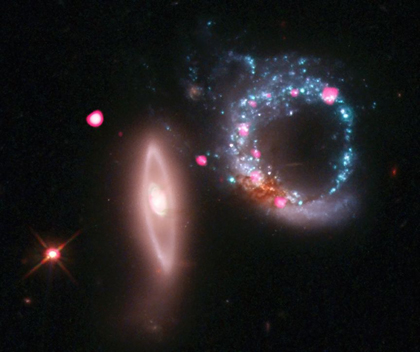
Just in time for Valentine's Day comes a new image of a ring -- not of jewels -- but of black holes. This composite image of Arp 147, a pair of interacting galaxies located about 430 million light years from Earth, shows X-rays from the NASA's Chandra X-ray Observatory (pink) and optical data from the Hubble Space Telescope (red, green, blue) produced by the Space Telescope Science Institute (STScI) in Baltimore, Md.
Arp 147 contains the remnant of a spiral galaxy (right) that collided with the elliptical galaxy on the left. This collision has produced an expanding wave of star formation that shows up as a blue ring containing in abundance of massive young stars. These stars race through their evolution in a few million years or less and explode as supernovas, leaving behind neutron stars and black holes.
Chandra Images Torrent of Star Formation
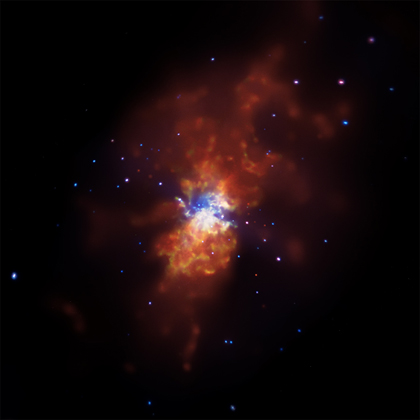
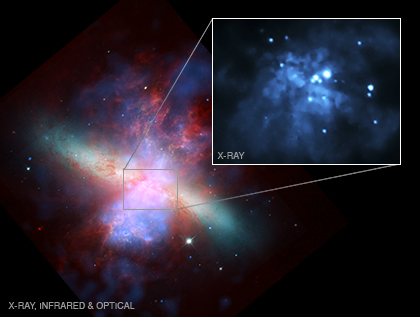
A new Chandra X-ray Observatory image of Messier 82, or M82, shows the result of star formation on overdrive. M82 is located about 12 million light years from Earth and is the nearest place to us where the conditions are similar to those when the Universe was much younger with lots of stars forming.
M82 is a so-called starburst galaxy, where stars are forming at rates that are tens or even hundreds of times higher than in a normal galaxy. The burst of star birth may be caused by a close encounter or collision with another galaxy, which sends shock waves rushing through the galaxy. In the case of M82, astronomers think that a brush with its neighbor galaxy M81 millions of years ago set off this torrent of star formation.
A Galactic Spectacle
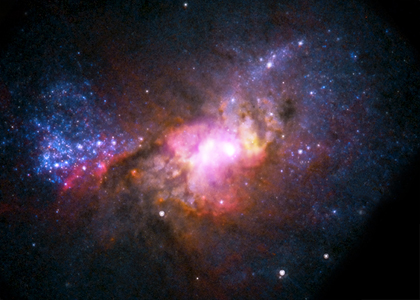
A beautiful new image of two colliding galaxies has been released by NASA's Great Observatories. The Antennae galaxies, located about 62 million light years from Earth, are shown in this composite image from the Chandra X-ray Observatory (blue), the Hubble Space Telescope (gold and brown), and the Spitzer Space Telescope (red). The Antennae galaxies take their name from the long antenna-like "arms," seen in wide-angle views of the system. These features were produced by tidal forces generated in the collision.
What Triggers Cosmology's Most Important Explosions?
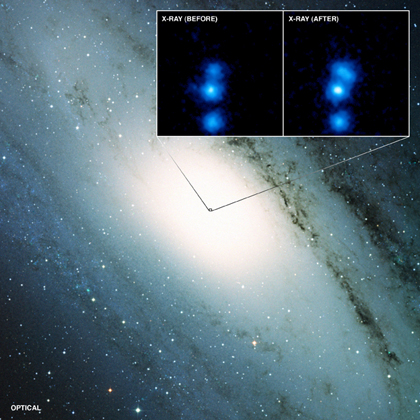
The work by Gilfanov and Bogdan described in the recent Chandra Press release represents a major advance in understanding the origin of Type Ia supernovas. Here, in Q & A format, we give some of the backstory of this important discovery.
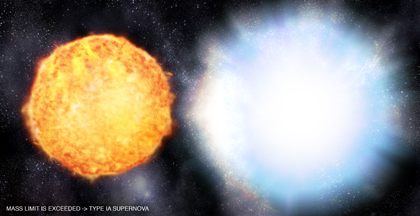
Illustration: NASA/CXC/M.Weiss
NASA's Chandra Reveals Origin of Key Cosmic Explosions
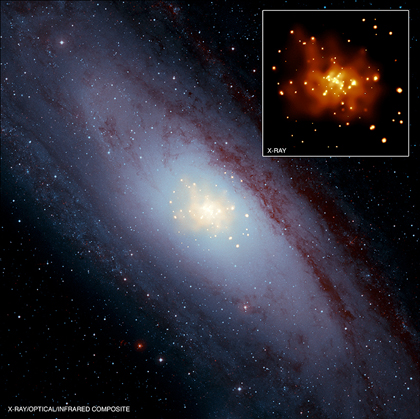
This composite image of M31 (also known as the Andromeda galaxy) shows X-ray data from NASA's Chandra X-ray Observatory in gold, optical data from the Digitized Sky Survey in light blue and infrared data from the Spitzer Space Telescope in red. The Chandra data covers only the central region of M31 as shown in the inset box for the image.

NASA's Great Observatories Examine the Galactic Center Region
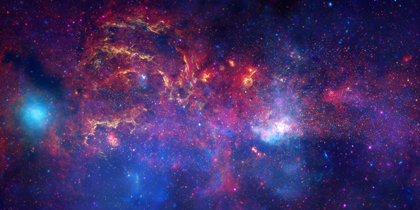
In celebration of the International Year of Astronomy 2009, NASA's Great Observatories -- the Hubble Space Telescope, the Spitzer Space Telescope, and the Chandra X-ray Observatory -- have collaborated to produce an unprecedented image of the central region of our Milky Way galaxy.