
Famous Supernova Reveals Clues About Crucial Cosmic Distance Markers
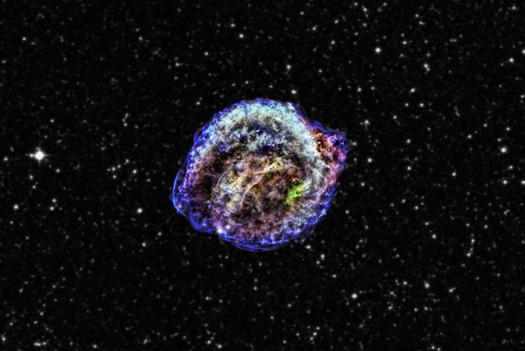
This is the remnant of Kepler's supernova, the famous explosion that was discovered by Johannes Kepler in 1604. The red, green and blue colors show low, intermediate and high energy X-rays observed with NASA's Chandra X-ray Observatory, and the star field is from the Digitized Sky Survey.
As reported in our press release, a new study has used Chandra to identify what triggered this explosion. It had already been shown that the type of explosion was a so-called Type Ia supernova, the thermonuclear explosion of a white dwarf star. These supernovas are important cosmic distance markers for tracking the accelerated expansion of the Universe.
Taking Another Look at a Historical Supernova
We are delighted to welcome Mary Burkey as a guest blogger today. Mary is first author of a paper, describing the trigger mechanism for the Kepler supernova, that is the subject of our latest press release. She grew up in Raleigh, North Carolina and is in her last semester at North Carolina State University. When she graduates in May, she will have Bachelors degrees in Physics, Chemistry, and Applied Mathematics. After commencement, Mary will attend one of the graduate schools she is currently exploring and plans to obtain a PhD in Physics.
When people all over the world looked up into the night sky 409 years ago and saw a new star, they immediately began studying it. However, no one studied this new celestial object more closely than Johannes Kepler. Over several years, he synthesized his observations into a historical book, De Stella Nova, which later justified naming the star “Kepler’s supernova.”
NASA's Swift, Chandra Explore a Youthful 'Star Wreck'
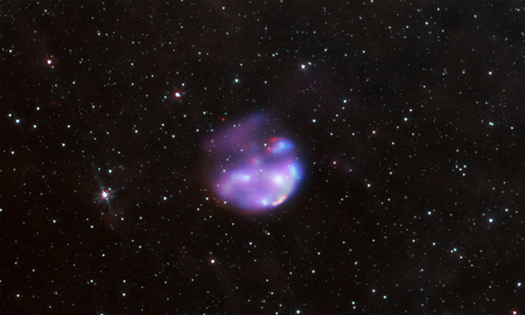
While performing an extensive X-ray survey of our galaxy's central regions, NASA's Swift satellite has uncovered the previously unknown remains of a shattered star. Designated G306.3-0.9 after the coordinates of its sky position, the new object ranks among the youngest-known supernova remnants in our Milky Way galaxy.
Probing Extreme Matter Through Observations of Neutron Stars
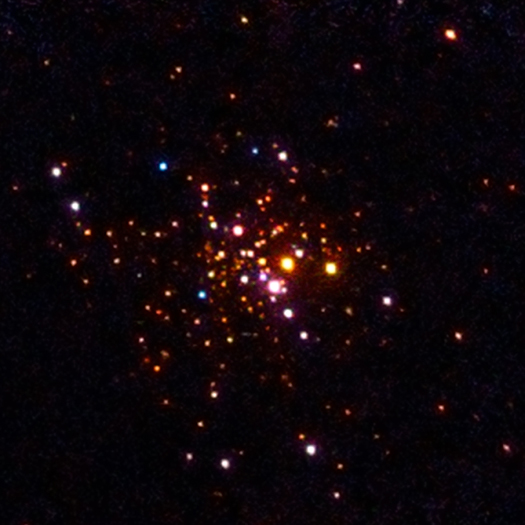
Neutron stars, the ultra-dense cores left behind after massive stars collapse, contain the densest matter known in the Universe outside of a black hole . New results from Chandra and other X-ray telescopes have provided one of the most reliable determinations yet of the relation between the radius of a neutron star and its mass. These results constrain how nuclear matter - protons and neutrons, and their constituent quarks, interact under the extreme conditions found in neutron stars.
Meet an Astronomer: Paul Green (Part I)
Paul Green is an astrophysicist at the Harvard-Smithsonian Center for Astrophysics. His scientific research includes the study of quasars and carbon stars. He pursues these topics while working in Chandra's Director's Office, helping to ensure that the science of the telescope gets done smoothly. When he's not doing all of these things, Paul is also known to play a mean bass guitar.
Chandra Data: Behind the Scenes of W49B
Joe DePasquale, Science Imager for NASA's Chandra X-ray Observatory, gives a pictorial tour behind the scenes on processing our latest Chandra press release image, supernova remnant W49B
I thought it might be useful to take a quick look at the various components that went into making the image for W49B. The release has sparked some attention and discussion on black holes, as well as how (and why) images such as these are colored. The processing of W49B included a combination of Chandra's CIAO software, PixInsight and Photoshop. The colors applied are representative, as we are translating something invisible to our eyes into something we can see. The image combines X-rays from NASA's Chandra X-ray Observatory in blue and green, radio data from the NSF's Very Large Array in pink, and infrared data from Caltech's Palomar Observatory in yellow. Enjoy, and feel free to ask any questions.
Rare Explosion May Have Created Our Galaxy's Youngest Black Hole
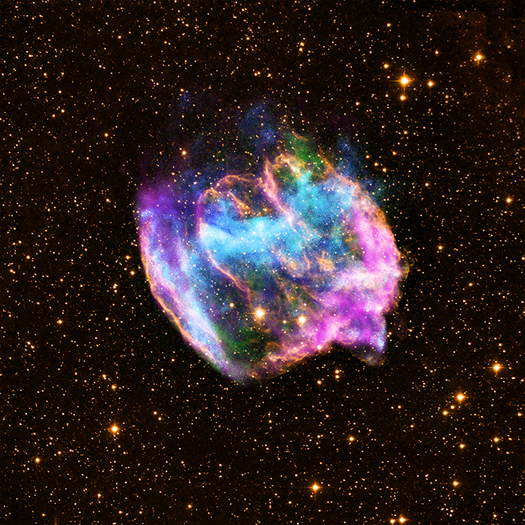
The highly distorted supernova remnant shown in this image may contain the most recent black hole formed in the Milky Way galaxy. The image combines X-rays from NASA's Chandra X-ray Observatory in blue and green, radio data from the NSF's Very Large Array in pink, and infrared data from Caltech's Palomar Observatory in yellow.
Exotic Supernovas in our own Galactic Backyard

We are delighted to welcome Laura Lopez as a guest blogger today. Laura is first author of a paper describing the rare explosion that may have created the youngest known black hole in our Galaxy. Laura Lopez is currently a NASA Einstein Fellow and Pappalardo Fellow in Physics at MIT. Laura received her PhD in astronomy & astrophysics from the University of California Santa Cruz in 2011. Before her time at UCSC, she earned her bachelors degree in physics from MIT in 2004. Laura is originally from Barrington, IL, a northwest suburb of Chicago. Her research focuses on probing the beginning and ending of the stellar life cycle: how stars are born and how stars end their lives through supernova explosions.
A few years ago when I was a bright-eyed PhD student, I stumbled upon a press release making a provocative argument: a thousand year old supernova remnant in our Galaxy called W49B may have formed from a gamma-ray burst. Gamma-ray bursts (GRBs) are extreme supernova explosions thought to mark the end of the lives of some very massive stars, and they are the most energetic and luminous events in the Universe. Although astronomers have now found several hundred gamma-ray bursts, these explosions tend to be billions of light years away. So the claim that one may have occurred in our own Galaxy seemed astounding. It got me thinking: what would a gamma-ray burst look like after a thousand years, and what would it leave behind?
Women In The High-Energy Universe: Megan Watzke
Megan Watzke is the press officer for NASA's Chandra X-ray Observatory. Her responsibilities include writing press releases, organizing press conferences, and more for newsworthy results from the telescope. She is also a co-investigator in the "From Earth to the Universe," "From Earth to the Solar System," and "Here, There and Everywhere" projects.
Like many people who work in science, I had an interest in the subject since I was a little kid. I remember going to the public library at 7 or 8 years old and asking the librarian for books on pulsars and quasars (they sounded like the coolest things I had ever heard of.)
Stellar Effervescence on Display
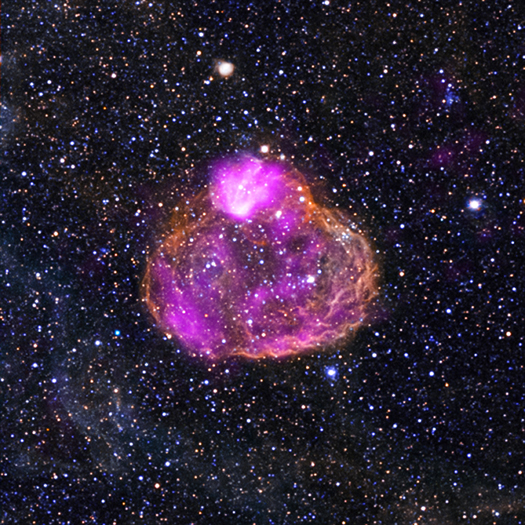
This composite image shows the superbubble DEM L50 (a.k.a. N186) located in the Large Magellanic Cloud about 160,000 light years from Earth. Superbubbles are found in regions where massive stars have formed in the last few million years. The massive stars produce intense radiation, expel matter at high speeds, and race through their evolution to explode as supernovas . The winds and supernova shock waves carve out huge cavities called superbubbles in the surrounding gas.