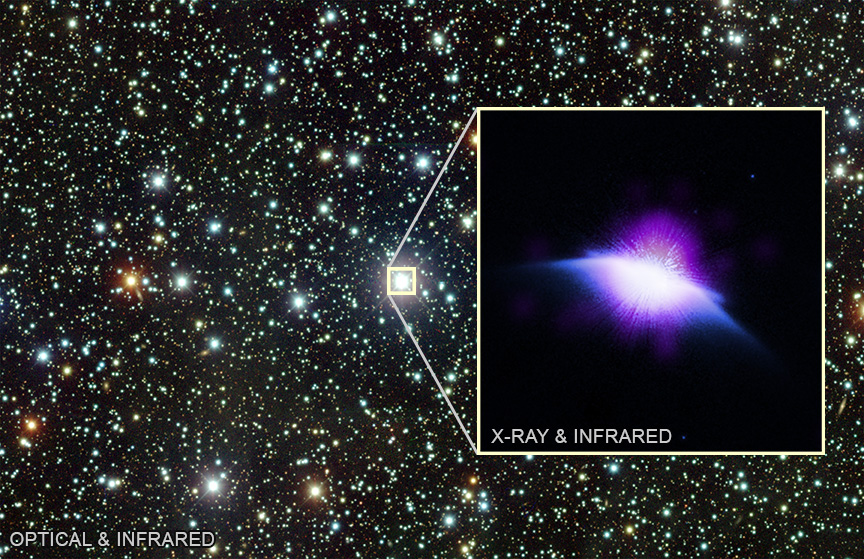

This image contains the first astrosphere, or wind-blown bubble, that astronomers have captured surrounding a star that is a younger version of our Sun. This discovery was made using NASA’s Chandra X-ray Observatory and is described in our latest press release.
The astrosphere was found around a star called HD 61005, which is located only about 120 light-years from Earth. HD 61005 has roughly the same mass and temperature as the Sun but is much younger with an age of about 100 million years, compared to the Sun’s age of about 5 billion years. This commonality with the Sun is important because the Sun has a similar bubble, which scientists call the heliosphere. The discovery of the astrosphere around HD 61005 gives astronomers a chance to study a structure that may be similar to what the Sun was embedded in several billion years ago.
In this composite image of HD 61005 in the inset, X-rays from Chandra (purple and white) have been combined with infrared data from Hubble (blue and white). Chandra reveals a bright source of X-rays in the center of the image, which is the star itself surrounded by the star’s astrosphere. The wing-like structure sweeping away from the star in the infrared image is dusty material that remained behind after the formation of the star. These wings have been swept backwards as they fly through space. The larger view is an optical image from the Cerro Tololo Inter-American Observatory in Chile (red, green, and blue) showing the field HD 61005 is located in.

An artist’s illustration depicts an astrosphere as a sphere, surrounding a star. The bow shock in blue — akin to a sonic boom in front of a supersonic plane — is caused by the motion of the star and its astrosphere as it pushes against and flies through gas in interstellar space. This illustration does not show the wings from the dusty debris.

Astronomers had previously nicknamed HD 61005 the “Moth” because the wings give it the appearance of this insect through infrared telescopes. Because it is so young, HD 61005 has winds of particles blowing from its surface that are about three times faster and 25 times denser than the wind from the Sun. These winds are blowing up the bubble and filling it with hot gas as it expands into much cooler gas and dust surrounding the star. This provides a window into how our Sun’s wind may have behaved early in its evolution.

Since the 1990s, astronomers have been trying to capture an image of an astrosphere around a Sun-like star. Chandra was able to detect the astrosphere around HD 61005 because the star system is producing X-rays as the stellar wind runs into cooler dust and gas that surrounds the star.
Previous observations showed that the interstellar matter surrounding HD 61005 is about a thousand times denser than that around the Sun. This environment, combined with Chandra’s high-resolution X-ray vision and the star’s proximity enabled this discovery. The astrosphere around HD 61005 has a diameter about 200 times the distance from the Earth to the Sun.
A paper describing these results has been accepted for publication by The Astrophysical Journal, led by Casey Lisse of Johns Hopkins University.
NASA's Marshall Space Flight Center in Huntsville, Alabama, manages the Chandra program. The Smithsonian Astrophysical Observatory's Chandra X-ray Center controls science operations from Cambridge, Massachusetts, and flight operations from Burlington, Massachusetts.
This release contains three main images, each offering a different take on the astrosphere surrounding a young star called HD 61005. An astrosphere is a wind-blown bubble full of gas and dust particles that encases a star as it pushes through interstellar space.
In this release, an optical image from the Cerro Tololo Inter-American Observatory in Chile shows HD 61005 in the context of its star field. Here, the star in question appears as a glowing, gleaming white dot surrounded by other glowing dots of similar and smaller sizes. The image is utterly packed with specks of light in shades of blue, white, gold, green, and red. At this distance, in an optical observation, the star's astrosphere is not discernible.
The second image is a composite, which presents a close-up of HD 61005 using infrared data from Hubble, and X-ray data from the Chandra X-ray Observatory. Here, the spherical star has a brilliant core bursting with white X-ray light. Ringing the white core is a neon purple glow; the astrosphere surrounding the star. A distinguishing feature of HD 61005 is a white, wedge-shaped tail with neon blue tips, which trails the fast-moving star. This tail is dusty material left behind after the star's formation. The wedge, or wing shape of the tail has earned the star the nickname 'Moth' by astronomers spying it through infrared telescopes.
The third image in this release is an artist's illustration of an astrosphere in action. Here, a large, pale purple ball soars from our right toward our left, into a misty brown cloud. The purple ball appears to be protected by a blue force field, which pushes the brown cloud aside as the ball dives in. In this illustration, the purple ball represents the astrosphere surrounding a star and the brown cloud is interstellar gas. The blue force field is a bow shock, a curved free-floating shock wave, similar to the sonic boom that travels in front of a supersonic plane. The bow shock is caused by the motion of the star and its astrosphere hurtling through space. This illustration features a series of faint lines representing wind patterns from HD 61005, but does not show the tail of debris found behind and beside HD 61005.
|
||||||||||||||||||||||||||||||