















CXC Home | Search | Help | Image Use Policy | Latest Images | Privacy | Accessibility | Glossary | Q&A
Galaxy Gallery:
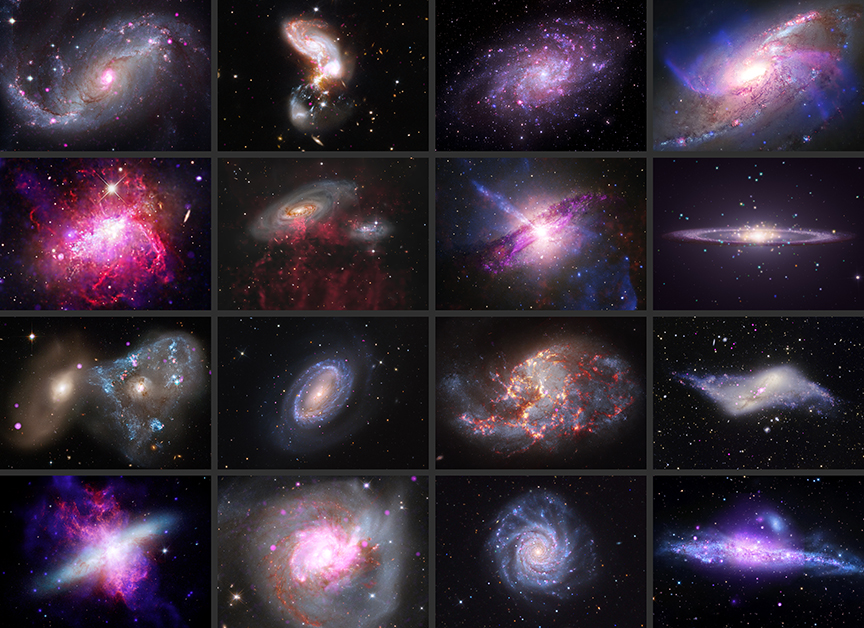
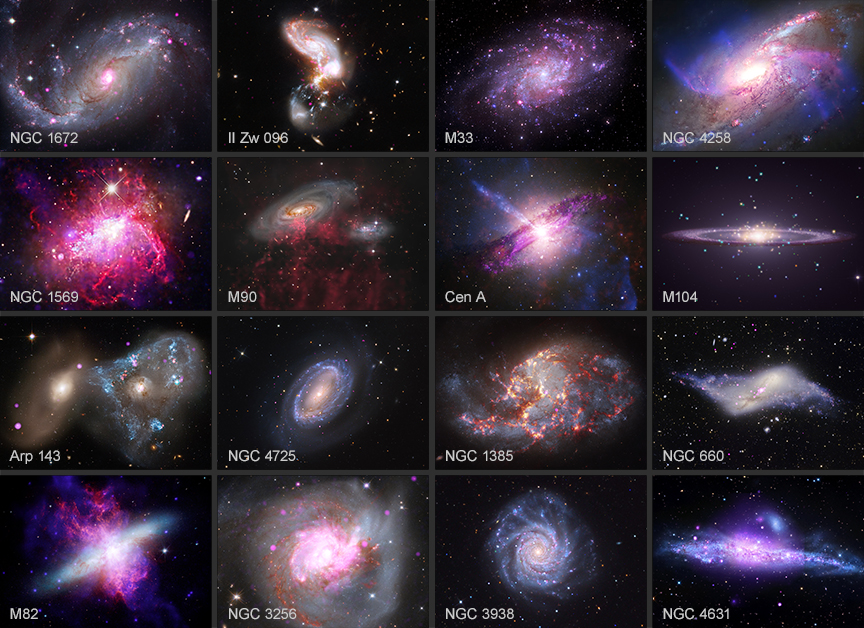
This gallery displays a collection of 16 galactic images from Chandra and other telescopes. Astronomers put galaxies into three main categories: spirals like our own Milky Way, ellipticals that are older and likely the results of mergers, and irregulars that can encompass a wide range of galactic phenomena. All types are represented in this collection. Each galactic image contains X-ray data from Chandra combined with data from telescopes such as NASA’s Webb, Hubble, IXPE, Swift, and NuSTAR, and others both in space and on the ground.
In the top row, starting from left and moving right, the galaxies are:
In the top row, starting from left and moving right, the galaxies are:
1
NGC 1672Credit: X-ray: NASA/CXC/SAO; Optical: NASA/ESA/STScI/Hubble Heritage Team; Infrared: NASA/ESA/CSA/STScI/J. Lee and T. Williams; Image Processing: NASA/CXC/SAO/L. Frattare, J. Major, K. Arcand

A barred spiral galaxy featuring a prominent central bar or bridge of stars that channels gas toward its core. Chandra X-rays (purple) highlight growing black holes along the bar and core, merged with Hubble optical light (white, yellow and soft blue) and JWST infrared dust filaments (red). Studying barred spirals in action can help reveal how gas in our own Milky Way, which is also a barred spiral, feeds its central black hole and forms new stars.
2
II Zw 096Credit: X-ray: NASA/CXC/SAO; Optical: NASA/ESA/STScI; Infrared: NASA/ESA/CSA/STScI; Image Processing: NASA/CXC/SAO/L. Frattare and J. Major

A chaotic, dust-shrouded system of merging galaxies forming stars at a furious rate. Chandra X-ray data (magenta) pinpoint powerful black hole activity and hot gas, while Hubble optical (blue and white) and Webb infrared (red and grey) data illuminate vast stellar nurseries hidden behind interstellar dust. Systems like II Zw 096 show us how powerful galaxy collisions shaped the early universe.
3
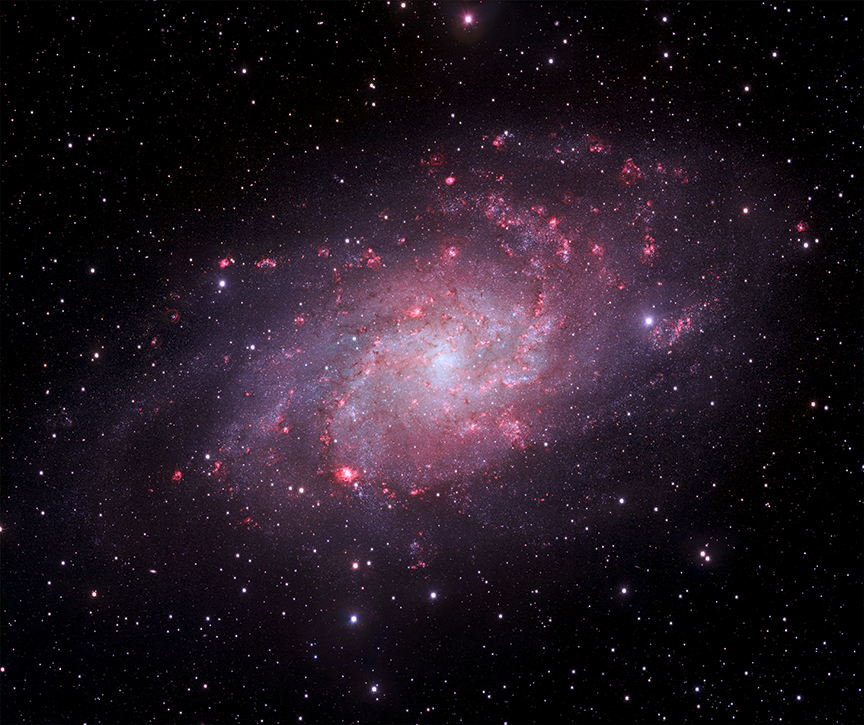
M33Credit: X-ray: NASA/CXC/SAO; Optical: ESO/VLT; UV: NASA/Swift; Image Processing: NASA/CXC/SAO/L. Frattare
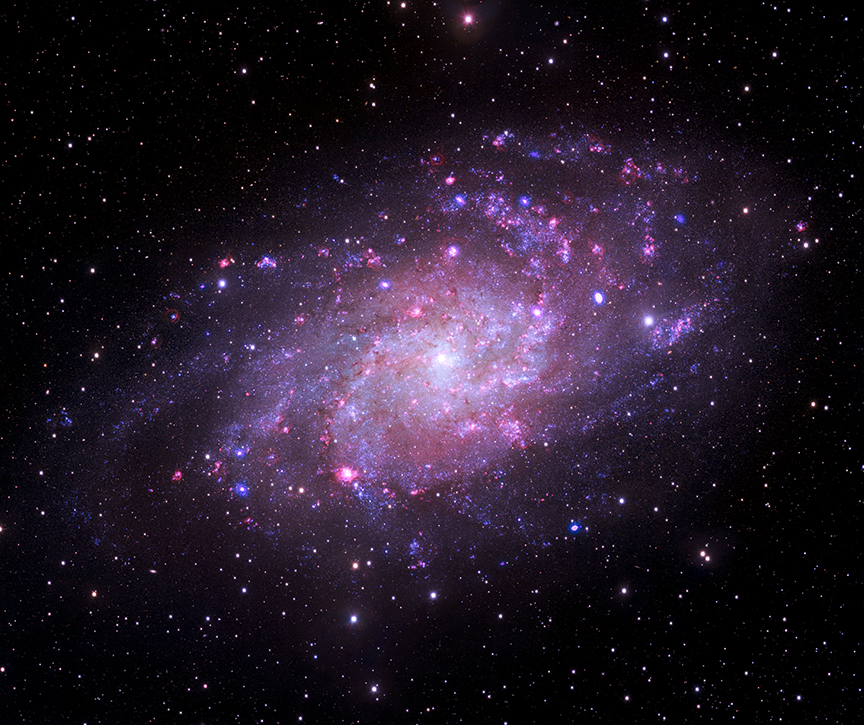
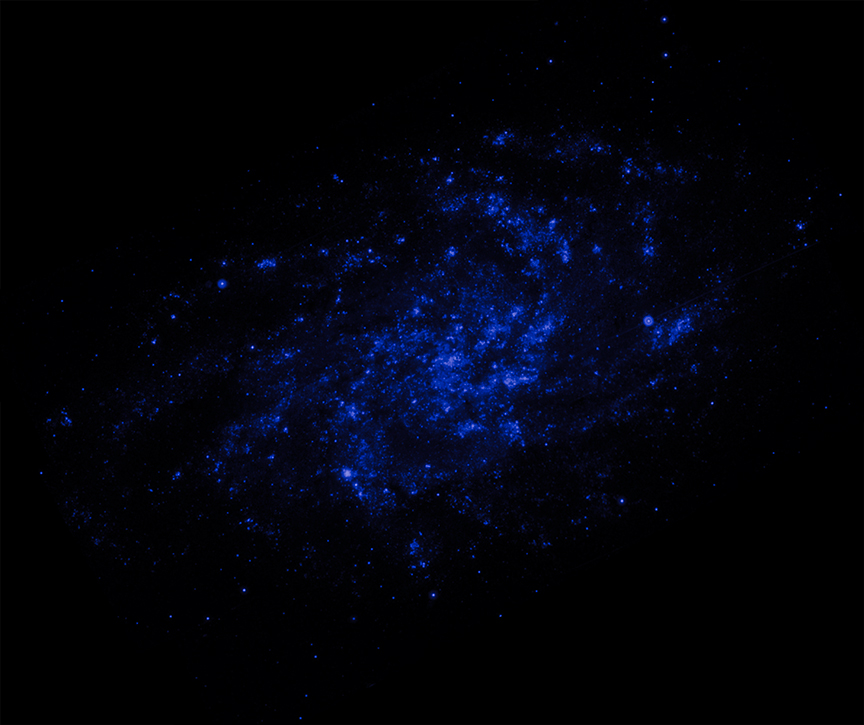
A nearby, face-on spiral galaxy whose clear spiral arms offer an unhindered view of its stellar engine. X-ray data from Chandra (purple) highlights point sources like neutron stars and stellar-mass black holes pulling material off companion stars (systems called X-ray binaries), while optical data from the Very Large Telescope’s MUSE instrument (pink and grey) maps glowing pockets of hydrogen gas. Ultraviolet data from NASA’s Swift telescope (blue) reveals populations of young, massive stars sizzling across the spiral arms. M33’s proximity to us allows astronomers to audit individual high-energy objects and map how stellar feedback affects a galaxy's ecosystem.
4
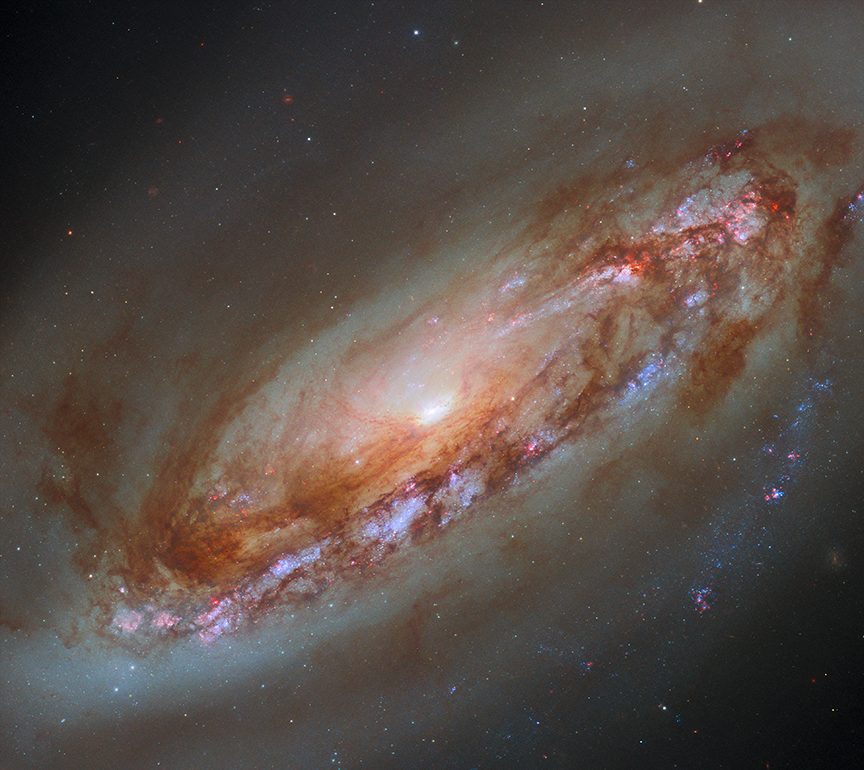
NGC 4258Credit: X-ray: NASA/CXC/SAO; Optical: NASA/ESA/STScI; Infrared: NASA/ESA/CSA/STScI; Image Processing: NASA/CXC/SAO/L. Frattare

A spiral galaxy famous for having two extra, "anomalous" spiral arms composed of hot gas. Chandra's X-rays (royal blue) show superheated shockwaves created by central black hole jets, combined with optical light from Hubble (red, yellow and pale blue) and infrared dust filaments from Webb (bright orange). M106 helps show how supermassive black holes can create structural features that mimic star-bearing spiral arms, influencing a galaxy's evolution.
5
NGC 1569Credit: X-ray: (XMM):ESA/XMM-Newton, (Chandra): NASA/CXC/SAO; Optical: Univ.of Arizona/Mt Lemmon SkyCenter/Adam Block/Josep Drudis; Image Processing: NASA?CXC/SAO/L. Frattare

A compact dwarf irregular galaxy undergoing a violent, compact burst of star formation. Chandra and XMM-Newton observations (blue and purple) reveal massive bubbles of million-degree gas inflated by stellar winds, set against a backdrop of optical light (magenta, orange and white) imaged by Adam Block. Dwarf starburst galaxies can serve as local laboratories for studying the conditions of the early universe, where small, primitive galaxies formed stars at frantic rates.
6
M90Credit: X-ray: NASA/CXC/SAO; Optical: NASA/ESA/D. Thilker/J. Lee/PHANGS-HST Team; Full-field: Tim Martin; Image Processing: NASA/CXC/SAO/L. Frattare
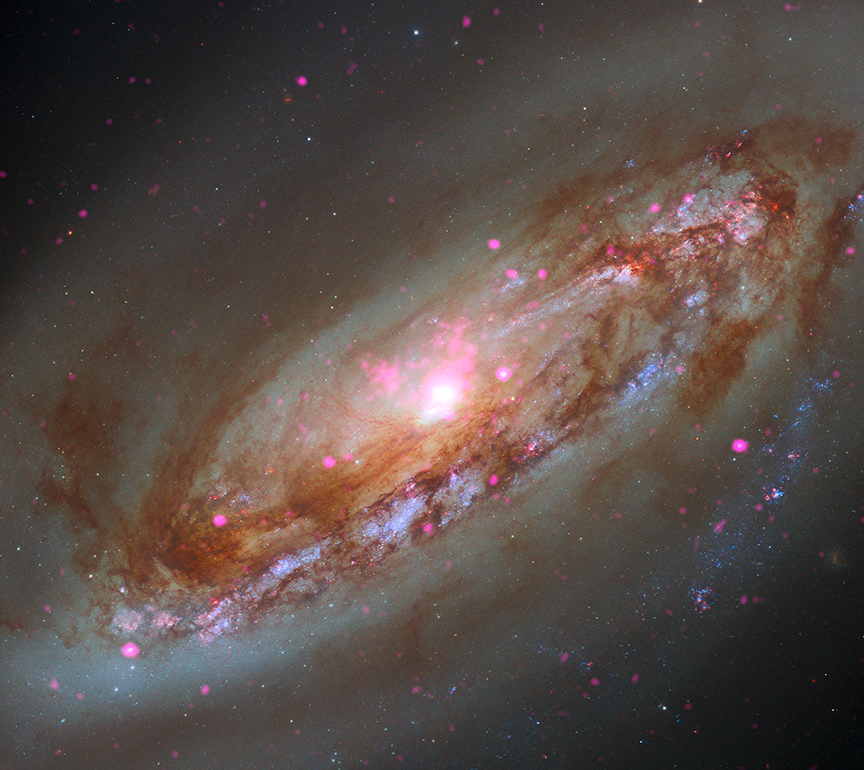
A large spiral galaxy that is being stripped of its gas as it plunges at high speed through hot gas in the Virgo Cluster of galaxies. Chandra’s X-ray data (magenta) pinpoints high-energy point sources—such as X-ray binaries and supernova remnants—and diffuse hot gas nestled within the spiral disk imaged by Hubble (blue, brown and gold). A ground-based optical light image taken from New Mexico by Timothy Martin reveals red filaments of hydrogen gas streaming over 300,000 light-years behind the galaxy as it falls into the Virgo Cluster.
7
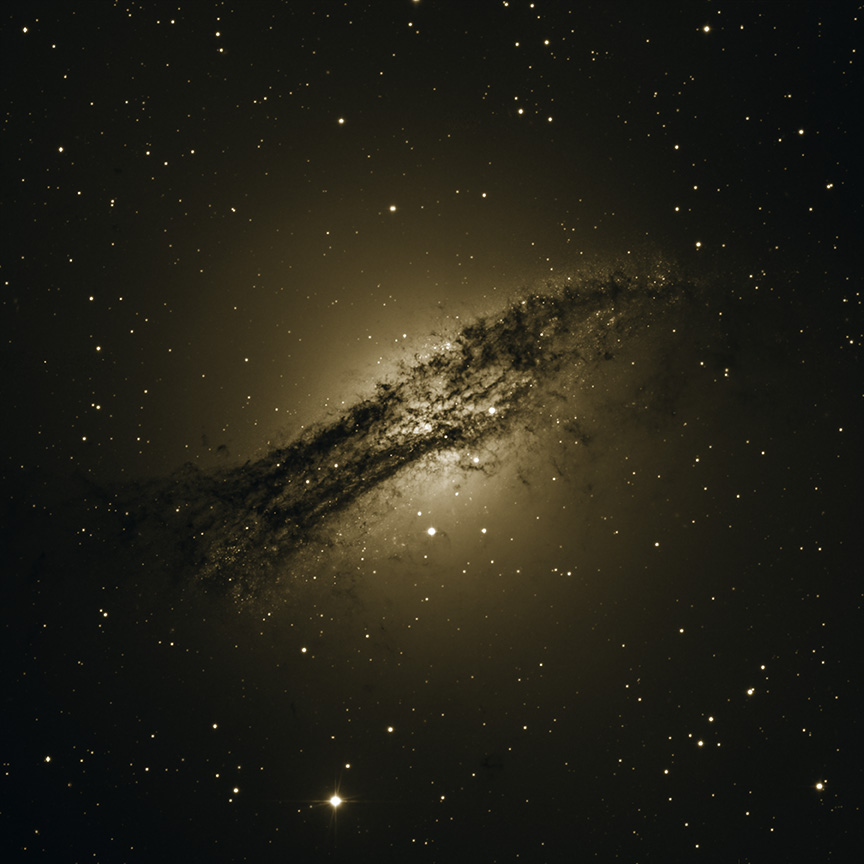
Centaurus ACredit: X-ray: (Chandra) NASA/CXC/SAO, X-ray (IXPE): NASA/MSFC; Optical: ESO; Infrared: NASA/ESA/CSA/STScI; Image Processing: NASA/CXC/SAO/L. Frattare, K. Arcand, and J. Major
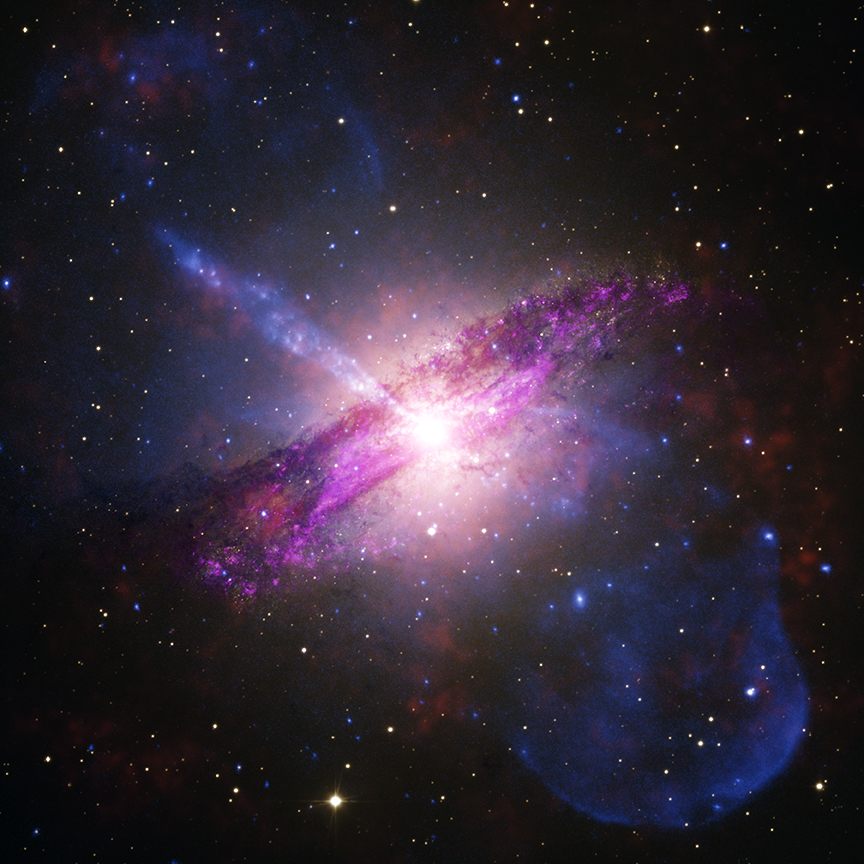
A giant elliptical galaxy undergoing a dusty merger, featuring a powerful jet of particles blasting tens of thousands of light-years into space. Chandra’s X-rays (blue) showcase the high-energy jet, with additional X-rays from IXPE (orange), while Webb infrared (magenta) and optical light (amber and white) from the European Southern Observatory expose a dark, churning dust lane. As one of the closest active galaxies to Earth, Cen A allows astronomers to study the effects of supermassive black hole jets in extraordinary detail.
8
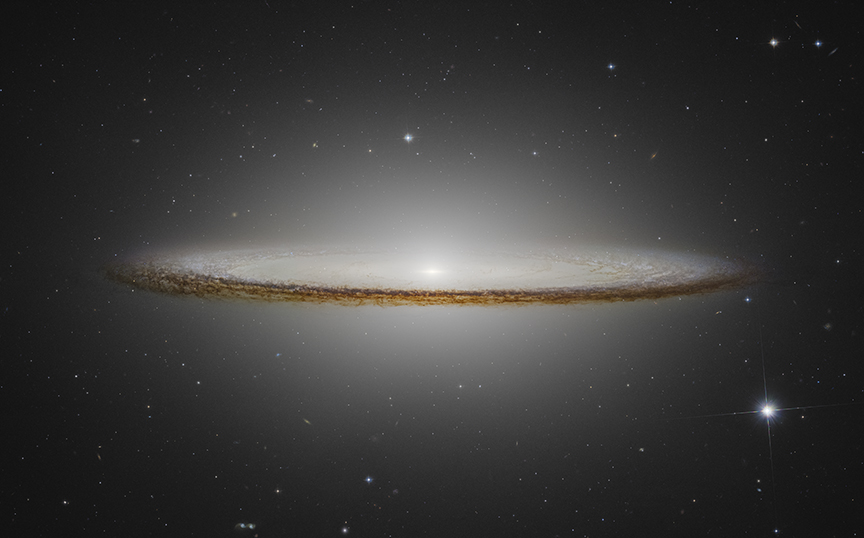
M104Credit: X-ray: NASA/CXC/SAO; Optical:NASA/Hubble Heritage Team/AURA/STScI; Infrared: NASA/ESA/CSA/STScI; Image Processing: NASA/CXC/SAO/L. Frattare
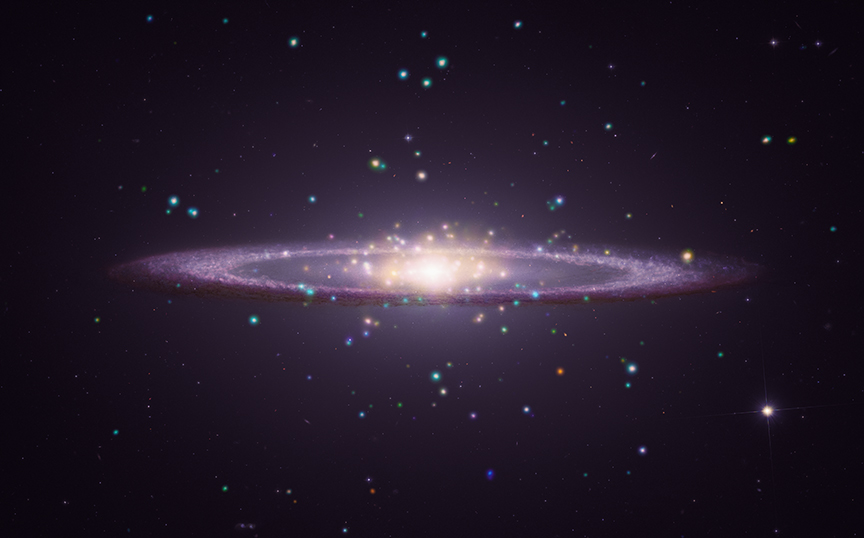
Famous for its broad central bulge and dark outer dust ring, this galaxy sits at a nearly edge-on tilt to Earth. Chandra X-rays (cyan and orange) isolate compact point sources and hot gas in the galaxy's sprawling halo, merged with Hubble optical light (warm white) and Webb infrared vision (purple-red dust lane). Studying M104 may help bridge the gap between spirals and ellipticals, helping astronomers better understand how a galaxy's giant outer cloud of stars grows and ages alongside its inner disk.
9
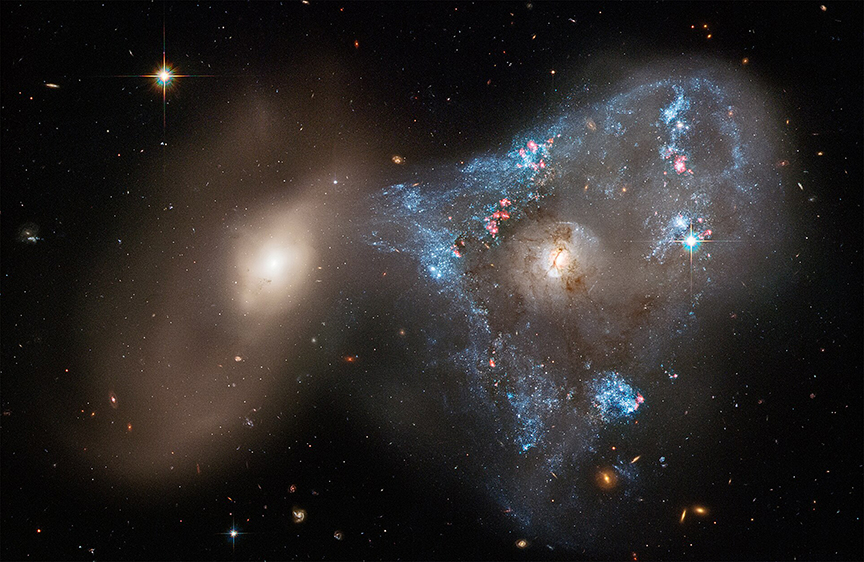
Arp 143Credit: X-ray: NASA/CXC/SAO; Optical: NASA/ESA/STScI/J. Dalcanton; Image Processing: NASA/CXC/SAO/L. Frattare
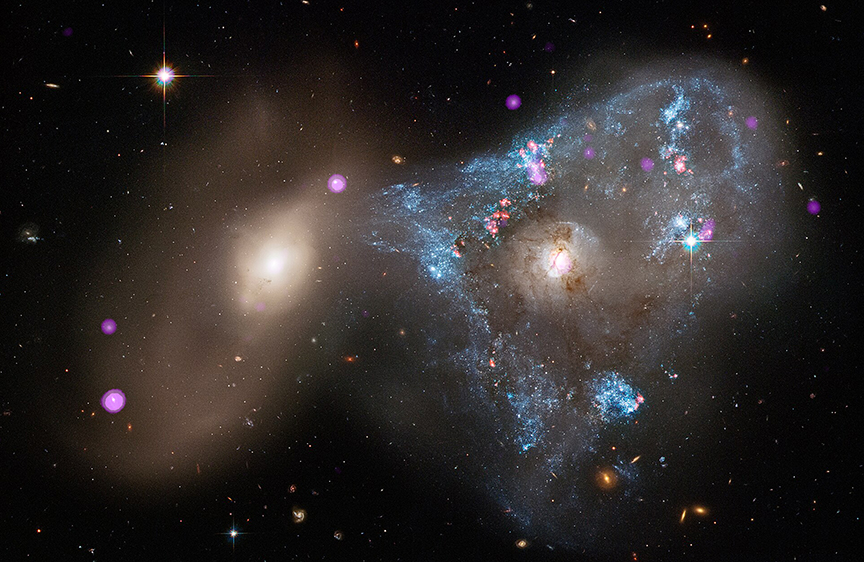
This ring galaxy system formed when a smaller companion galaxy punched straight through its center like a bullseye, creating a powerful cosmic shockwave. Chandra X-rays (purple) uncover bright X-ray binary systems scattered along the collision shock wave, laid over Hubble’s optical image (blue and white) of expanding stellar rings. Such head-on collisions can trigger vast ripple effects, sparking huge waves of star birth across entire galaxies.
10
NGC 4725Credit: X-ray: NASA/CXC/SAO; Optical: NASA/ESA/STScI/NAOJ/R. Gendler; Image Processing: NASA/CXC/SAO/L. Frattare

A "one-armed" barred spiral galaxy surrounded by a prominent star-forming ring. Chandra's X-ray data (magenta) pinpoints several bright X-ray sources, likely caused by growing black holes, embedded within the sweeping optical disk (soft blue and white) captured with the Mt. Lemmon Observatory. Galaxies with unusual single arms can offer a window into how the gravity from a passing galaxy can trigger bursts of star formation.
11
NGC 1385Credit: X-ray: NASA/CXC/SAO; Optical: NASA/ESA/STScI; Infrared: NASA/ESA/CSA/STScI; Image Processing: NASA/CXC/SAO/L. Frattare

A barred spiral galaxy packed with regions where stars are actively forming. Chandra X-ray data (magenta) highlights stellar nurseries and X-ray binaries scattered along dusty spiral structures brought to life by Hubble optical (white and grey) and Webb infrared (orange and red) observations. Comparing multiwavelength data of barred spirals containing active star formation helps scientists map how local starbursts build up galactic mass over time.
12
NGC 660Credit: X-ray: NASA/CXC/SAO; Optical:NSF/International Gemini Observatory/AURA; Image Processing: NASA/CXC/SAO/L. Frattare

A rare "polar ring" galaxy where a tilted outer ring of stars and dust rotates over the galaxy's poles, an unusual structure likely caused by a collision with another galaxy about a billion years ago. Chandra’s X-rays (purple) reveal a possible growing supermassive black hole in the center of the galaxy, plus X-ray binaries nestled within the stars and dust captured by the Gemini Observatory in optical light (gold, blue and white). Studying polar rings teaches us about the diverse effects of stellar collisions on the shapes of galaxies.
13
M82Credit: X-ray: NASA/CXC/SAO; Optical: NASA/ESA/STScI; Infrared: NASA/ESA/CSA/STScI; Image Processing: NASA/CXC/SAO/L. Frattare, J. Major, and K. Arcand
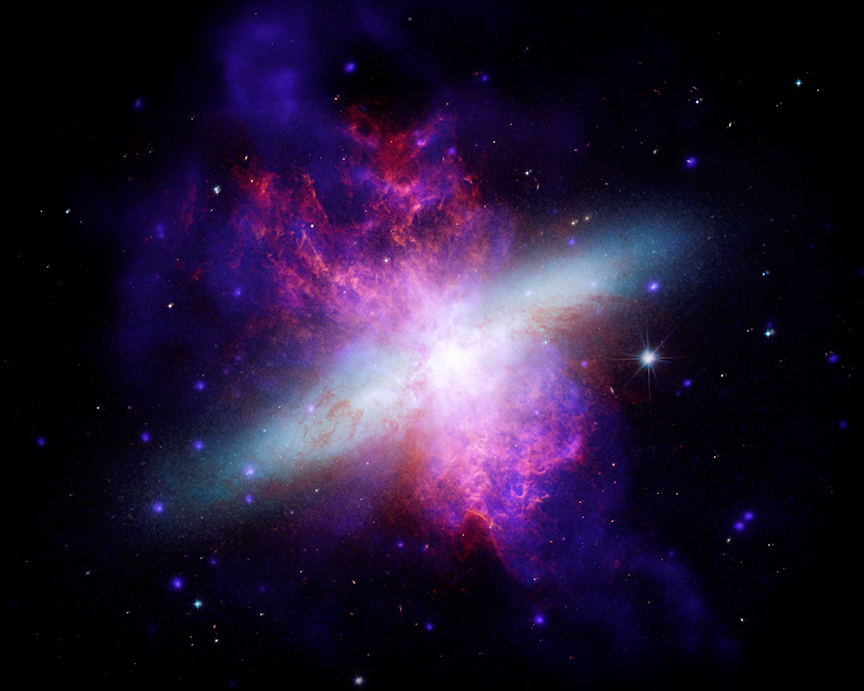
An irregular galaxy undergoing intense star formation because of a gravitational interaction with a neighboring galaxy hundreds of millions of years ago. Chandra X-rays (blue), supplemented by NuSTAR data, show towering superwinds of million-degree gas blowing thousands of light-years out of the galactic disk, with Hubble optical light (yellow, orange and white) showing the galaxy shape, and Webb and Spitzer detailing infrared dust emission (red). M82 was nicknamed the Cigar Galaxy mostly because of its edge-on angle to Earth, which makes its central disk look like an elongated, cigar-shaped oval with small optical telescopes. The galaxy illustrates how violent galactic "exhaust systems" can regulate a galaxy's growth by venting gas outwards.
14
NGC 3256Credit: X-ray: NASA/CXC/SAO; Optical: NASA/ESA/STScI; Infrared: NASA/ESA/CSA/STScI; Image Processing: NASA/CXC/SAO/L. Frattare

A pair of colliding, gas-rich spiral galaxies merging into a single massive system. Chandra’s X-ray data (pink) isolates point sources and shock-heated gas, Hubble’s optical light (blue and white) captures tidal tails of stars, and Webb’s infrared vision (red and orange) cuts through the dust to show hidden star formation. Galaxy collisions like this offer a preview of our far future, showing what might happen if our own Milky Way collides and merges with the nearby Andromeda Galaxy.
15
NGC 3938Credit: X-ray: NASA/CXC/SAO; Optical: Adam Block/Mount Lemmon SkyCenter/University of Arizona; Image Processing: NASA/CXC/SAO/L. Frattare

A face-on spiral galaxy whose orientation gives us an unobstructed view of its disk. X-ray emissions from Chandra (magenta) detail energetic X-ray binaries and supernova remnants scattered across dust lanes in an optical image (white, blue and gold) from Adam Block with Mt. Lemmon Observatory. Face-on orientations are important for galactic studies because they provide the most unobstructed views of a galaxy’s stars and gas.
16
NGC 4631Credit: X-ray: NASA/CXC/SAO; Optical: ©2011-2015 by R Jay GaBany, Cosmotography.com; Image Processing: NASA/CXC/SAO/L. Frattare

A spiral galaxy viewed from its side, featuring a giant halo of hot gas blowing out of its stellar disk. X-rays from Chandra and ESA’s XMM-Newton (purple and royal blue) trace hot gas driven out by supernovas and black holes and neutron stars pulling gas from their companions, while optical light (light blue, gold and white) from ground-based observer R. Jay GaBany showcases dense dust lanes. Edge-on views of galaxies allow astronomers to study how flat their stellar disks are and provide the clearest views of material located above or below the disk.
Return to: Galactic Gems Glisten in New Gallery From NASA's Chandra (August 25, 2026)


Revised: August 20, 2026