
Modeling, Mapping and Made with Code: Two Summer Internships at the Chandra Operations Control Center
We are very pleased to welcome two special guest contributors to the Chandra blog. Amy Nuccitelli and Jonathan Brande both spent the summer of 2016 working as interns with the Chandra X-ray Observatory team at its Operations Control Center. Amy Nuccitelli will enter her junior year as a mathematics major at James Madison University in Harrison, VA, while Jonathan is pursuing a major in astronomy and a minor in computer science at the University of Maryland, College Park. We thank Amy and Jonathan both for their hard work on the Chandra mission and also for taking the time to share their experiences with the Chandra bog.
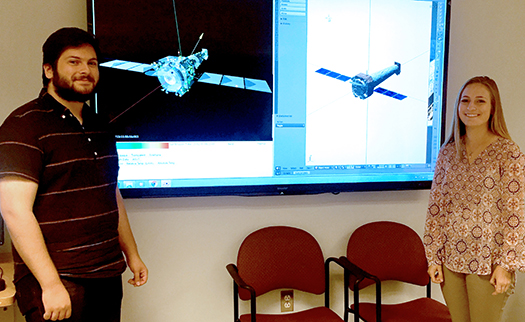
Jonathan Brande and Amy Nuccitelli
Poetry and Black Holes
We welcome back Jonathan Taylor as a guest blogger. Jonathan is a Senior Lecturer in Creative Writing at the University of Leicester, UK, along with an author and critic. He has written several poems for us in the past: “Black Hole in B-flat”, “History Lesson” and “!!**&@??”. He has also organized poetry competitions among his students, in blog posts here, here, here, here and here.
I was fascinated by Chandra’s press release of 27 June 2016, ‘Clandestine Black Hole May Represent New Population.’ The very title of the press release sounds ‘poetic,’ in the idea of ‘Clandestine’ – a concealed or secretive – Black Hole; and the findings described in the press release are even more so: having concluded that “a peculiar source of radio waves thought to be a distant galaxy is actually a nearby binary star system containing a low-mass star and a black hole,” astronomers have suggested that “there may be a vast number of black holes in our Galaxy that have gone unnoticed until now .... Because this study only covered a very small patch of sky, the implication is that there should be many of these quiet black holes around the Milky Way. The estimates are that tens of thousands to millions of these black holes could exist within our Galaxy, about three to thousands of times as many as previous studies have suggested.”
Supernova Ejected from the Pages of History
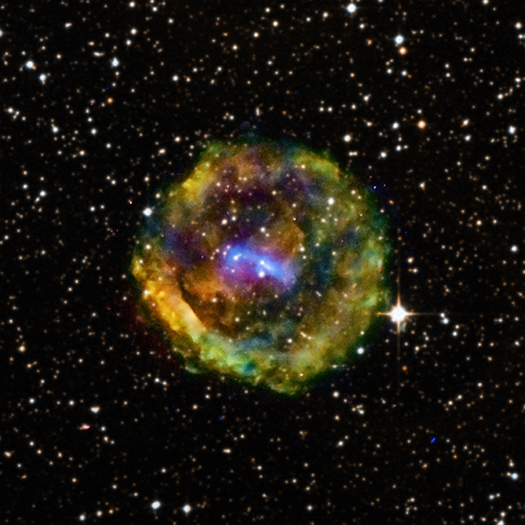
A new look at the debris from an exploded star in our galaxy has astronomers re-examining when the supernova actually happened. Recent observations of the supernova remnant called G11.2-0.3 with NASA's Chandra X-ray Observatory have stripped away its connection to an event recorded by the Chinese in 386 CE.
A Black Hole Story Told by a Cosmic Blob and Bubble
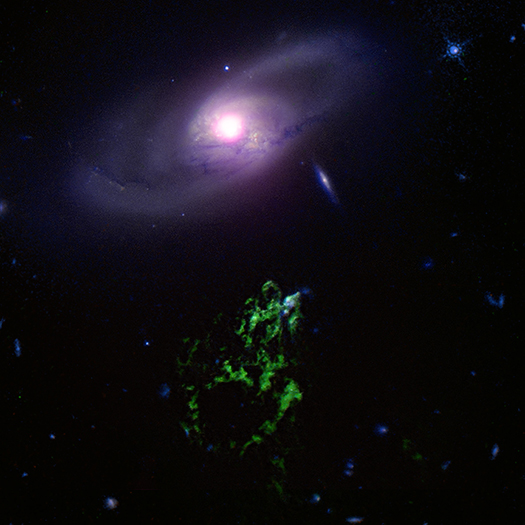
Two cosmic structures show evidence for a remarkable change in behavior of a supermassive black hole in a distant galaxy. Using data from NASA’s Chandra X-ray Observatory and other telescopes, astronomers are piecing together clues from a cosmic “blob” and a gas bubble that could be a new way to probe the past activity of a giant black hole and its effect on its host galaxy.
The Green Blob, a renowned cosmic structure also called “Hanny’s Voorwerp” (which means “Hanny’s object” in Dutch), is located about 680 million light years from Earth. This object was discovered in 2007 by Hanny van Arkel, at the time a school teacher, as part of the citizen science project called Galaxy Zoo.
BEHIND THE SCENES OF ‘ASTROLYMPICS’

On August 5th, the 2016 Olympic Summer Games will begin with the Opening Ceremonies in Rio de Janeiro, Brazil. A new project from NASA’s Chandra X-ray Observatory and its Communications group takes a look at the amazing feats performed by Olympic athletes and tries to provide context for them in an innovative way.
Taking a Supernova into the Third Dimension
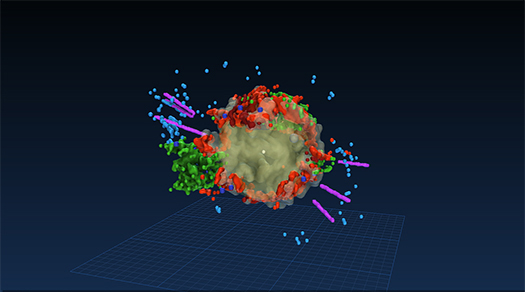
3D Supernova Remnant. Credit: NASA/CXC/SAO
The 'Astrolympics' Open in Time for Summer Games

With the Olympic Games in Rio nearly ready to begin, an innovative project blending science and sports is being unveiled. “AstrOlympics” relates the amazing feats of Olympic athletes with the spectacular phenomena found throughout space.
This latest project from NASA’s Chandra X-ray Observatory Communications group highlights the physical connections between sport and space. Examining various topics including speed, distance, time, mass, rotation, and pressure, AstrOlympics explores the impressive range of these different physical properties.
The Secrets of the Sun Revealed in the Stars
We are pleased to welcome Nick Wright as our guest blogger. Nick is the lead author on a paper featured in our latest press release, about how magnetic fields are generated in stars. He is an astrophysicist working at Keele University in the UK. He completed his PhD at University College London before moving to the Smithsonian Astrophysical Observatory to study X-ray emission from both young and old stars. After almost 5 years working in the US he returned to England as a Royal Astronomical Society research fellow at the University of Hertfordshire and is now an Ernest Rutherford Fellow at Keele University. When not studying the stars or writing about them on his blog, Nick enjoys cooking, gardening and travelling.

Nick Wright Credit: Nick Wright
Magnetic fields in the Sun and Sun-like stars are generated by a dynamo, a process involving the rotation of the star as well as convection, the rising and falling of hot gas in the star's interior. Understanding the magnetic dynamo of our Sun is important because it is responsible for a lot of interesting and energetic solar phenomena, some of which can have a considerable impact on our Earth and the wider Solar System. The Sun's magnetic field is responsible for sunspots on its surface, the 22-year magnetic activity cycle (the "Solar cycle"), the Solar wind that pummels planets throughout our Solar System and the ejections of large quantities of plasma – a gas composed of free electrons and free atomic nuclei – known as coronal mass ejections. This ejected material can have a serious impact on Earth, resulting in geomagnetic storms that disrupt radio transmissions, damage satellites and electrical grids, as well as harm astronauts or even people flying in airplanes at high altitudes.
Chandra Finds Evidence for Violent Stellar Merger
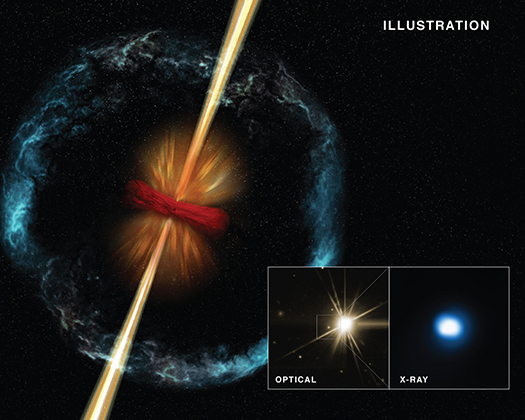
Gamma-ray bursts, or GRBs, are some of the most violent and energetic events in the Universe. Although these events are the most luminous explosions in the universe, a new study using NASA's Chandra X-ray Observatory, NASA's Swift satellite and other telescopes suggests that scientists may be missing a majority of these powerful cosmic detonations.
Tracking Down a Stealthy Black Hole
We are pleased to welcome Bailey Tetarenko as our guest blogger. She is the lead author on a paper featured in our latest press release about a possible new population of black holes in the Galaxy. Bailey received her undergraduate degree in Astrophysics at the University of Calgary and then a master’s in Physics at the University of Alberta in 2014. She is now two years into her Ph.D. in Physics at the University of Alberta, where she is studying the black hole population of the Milky Way.
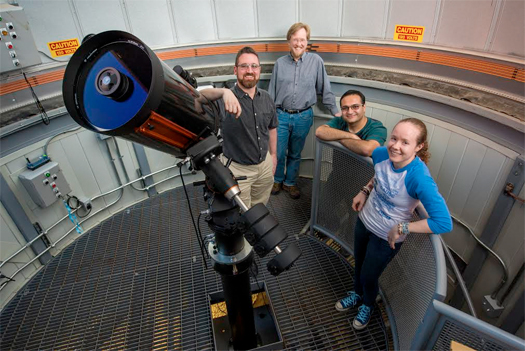
From right to left Bailey Tetarenko, Dr. Arash Bahramian and Dr. Craig Heinke and Dr. Greg Sivakoff. Credit: John Ulan
For fans of black holes, we live in exciting times. Nearly all of our empirical knowledge about stellar mass black holes – that is, black holes weighing about 5 to 35 times the mass of the sun – comes from black hole X-ray binary systems. In these systems a black hole pulls in material from a nearby companion star, causing the system to become very bright in X-rays. But, recently gravitational waves have been detected from pairs of distant black holes that emit no electromagnetic radiation (a.k.a. all forms of light). And now, my team's work suggests that there are many black hole X-ray binaries in our own Milky Way that emit relatively little X-rays.