
Quasars & Active Galaxies
NASA Telescopes Set Limits on Space-time Quantum Foam
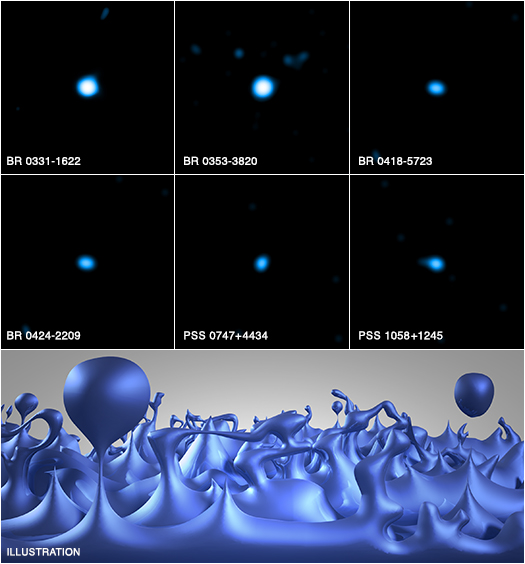
A new study combining data from NASA's Chandra X-ray Observatory and Fermi Gamma-ray Telescope, and the Very Energetic Radiation Imaging Telescope Array (VERITAS) in Arizona is helping scientists set limits on the quantum nature of space-time on extremely tiny scales, as explained in our latest press release.
Certain aspects of quantum mechanics predict that space-time - the three dimensions of space plus time -- would not be smooth on the scale of about ten times a billionth of a trillionth of the diameter of a hydrogen atom's nucleus. They refer to the structure that may exist at this extremely small size as "space-time foam." This artist's illustration depicts how the foamy structure of space-time may appear, showing tiny bubbles quadrillions of times smaller than the nucleus of an atom that are constantly fluctuating and last for only infinitesimal fractions of a second.
Supermassive Black Holes Running at Full Tilt

Bin Luo
We are very pleased to welcome Bin Luo as a guest blogger today. He led the study on supermassive black holes that is the subject of our latest press release. Bin obtained a PhD degree in Astronomy and Astrophysics from the Pennsylvania State University in 2010, working on the Chandra Deep Field surveys. He then worked as a postdoctoral fellow at the Harvard-Smithsonian Center for Astrophysics, and later back at the Pennsylvania State University. He will start a faculty position in September 2015 at the Nanjing University in China. Bin has mainly been working on X-ray studies of supermassive black holes in the centers of galaxies. He is now leading the data analysis of the 7-million-second (81 days) Chandra Deep Field-South survey, the deepest Chandra observation ever performed.
I have been studying the X-ray emission from accreting supermassive black holes since I was a graduate student. These monstrous black holes – quasars fueled by large amounts of gas and dust, consuming of the order of a couple solar masses per year – are known nearly universally to be strong X-ray emitters. Meanwhile, strong line emission – that is, light coming from a narrow range of wavelengths – is also a hallmark of quasar spectra in optical and ultraviolet bands. Therefore, I was quite puzzled when we discovered that a small group of quasars with remarkably weak ultraviolet line emission are often extremely X-ray weak. The pioneering work was led by Jianfeng Wu, Niel Brandt, and Pat Hall in 2011 and 2012, where the X-ray emission from 19 such quasars was examined. What makes things even more interesting is that for a subgroup of these quasars selected with refined ultraviolet properties, almost 100% are weak in X-ray light.
NASA's Chandra Suggests Black Holes Gorging at Excessive Rates
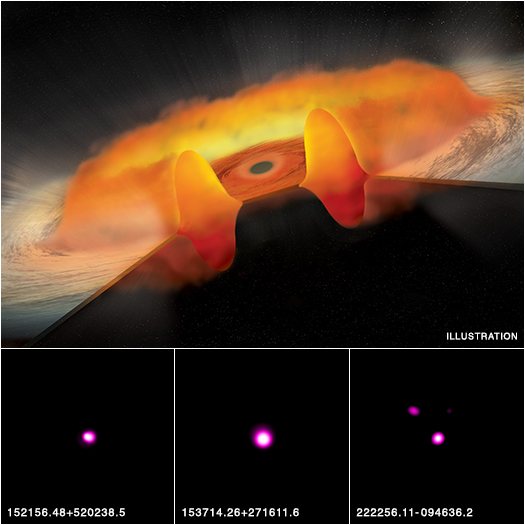
Astronomers have studied 51 quasars with NASA's Chandra X-ray Observatory and found they may represent an unusual population of black holes that consume excessive amounts of matter, as described in our latest press release. Quasars are objects that have supermassive black holes that also shine very brightly in different types of light. By examining the X-ray properties with Chandra, and combining them with data from ultraviolet and visible light observations, scientists are trying to determine exactly how these large black holes grow so quickly in the early Universe.
Our Universe in Color
Today we released six new images from Chandra’s vast data archive. Each one of these astronomical images combines X-rays from Chandra with data from telescopes that detect different types of light such as infrared, radio, and visible light.
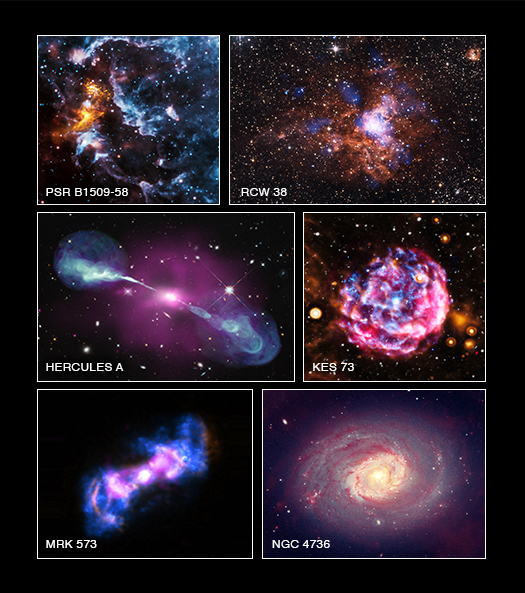
Chandra's Archives Come to Life
Every year, NASA's Chandra X-ray Observatory looks at hundreds of objects throughout space to help expand our understanding of the Universe. Ultimately, these data are stored in the Chandra Data Archive, an electronic repository that provides access to these unique X-ray findings for anyone who would like to explore them. With the passing of Chandra's 15th anniversary in operation on August 26, 1999, the archive continues to grow as each successive year adds to the enormous and invaluable dataset.
Chandra & XMM-Newton Provide Direct Measurement of Distant Black Hole's Spin
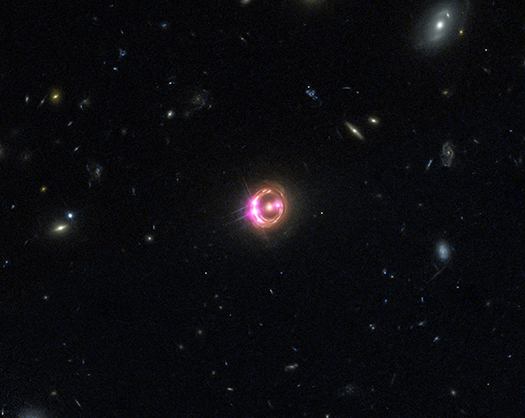
Multiple images of a distant quasar are visible in this combined view from NASA's Chandra X-ray Observatory and the Hubble Space Telescope. The Chandra data, along with data from ESA's XMM-Newton, were used to directly measure the spin of the supermassive black hole powering this quasar. This is the most distant black hole where such a measurement has been made, as reported in our press release.
A New Look at an Old Friend
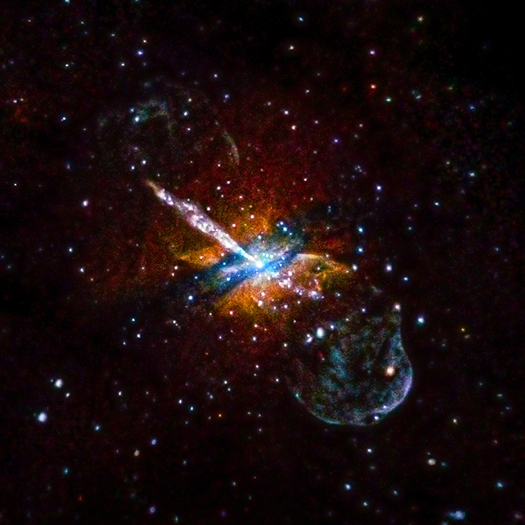
Astronomers have used NASA's Chandra X-ray Observatory and a suite of other telescopes to reveal one of the most powerful black holes known. The black hole has created enormous structures in the hot gas surrounding it and prevented trillions of stars from forming.
Black Hole Powered Jets Plow Into Galaxy
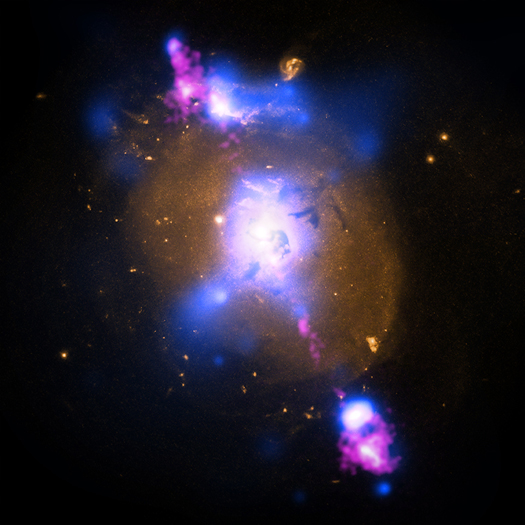
This composite image of a galaxy illustrates how the intense gravity of a supermassive black hole can be tapped to generate immense power. The image contains X-ray data from NASA's Chandra X-ray Observatory (blue), optical light obtained with the Hubble Space Telescope (gold) and radio waves from the NSF's Very Large Array (pink).
How to stumble into a PhD project, and how it can follow you

Teddy Cheung,
Credit: Craig Walker
We are delighted to welcome Teddy Cheung, from the National Academy of Sciences, and resident at the Naval Research Laboratory in Washington DC, to give a guest blog post today. Teddy is first author of a paper describing the discovery of the most distant X-ray jet detected to date. Here, he explains some of the background story behind this discovery.
When I started graduate school in 1999 at Brandeis University, exciting discoveries were being made down the road in Cambridge, Massachusetts, with the then newly launched Chandra X-ray Observatory. The first Chandra image unexpectedly revealed a bright X-ray jet from a distant quasar (https://chandra.harvard.edu/press/99_releases/press_082399.html) and the research groups at SAO and MIT were puzzling over it. But it took me leaving Boston to find my eventual connection.
I spent the summer of 2000 at the Space Telescope Science Institute in Baltimore, Maryland, wanting to learn something entirely new and took on a project in Meg Urry's group studying the galaxies of BL Lac objects (a type of cousin to the quasars) using ground-based near-infrared data. Coincidentally, I shared an office with another graduate student working with Dr. Urry for the summer, Fabrizio Tavecchio from Italy, and they were at that time puzzling over the same Chandra jet detection. Little did I appreciate at the time, that this visit to Baltimore would lead back to my eventual PhD project at Brandeis on the Chandra quasar jets.
Record-Setting X-ray Jet Discovered
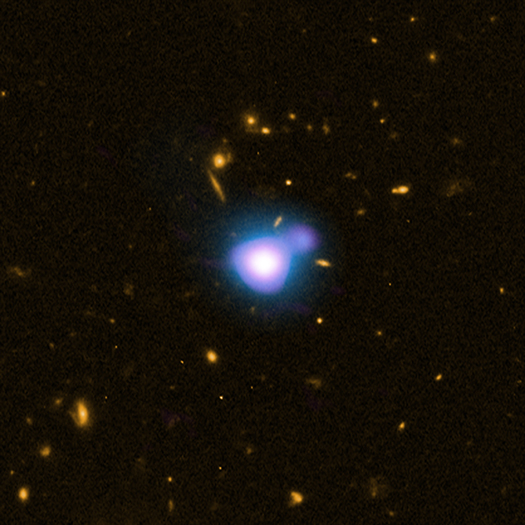
This composite image shows the most distant X-ray jet ever observed. X-ray data from NASA's Chandra X-ray Observatory are shown in blue, radio data from the NSF's Very Large Array are shown in purple and optical data from NASA's Hubble Space Telescope are shown in yellow. The jet was produced by a quasar named GB 1428+4217, or GB 1428 for short, and is located 12.4 billion light years from Earth. Labels for the quasar and jet can be seen by mousing over the image. The shape of the jet is very similar in the X-ray and radio data.