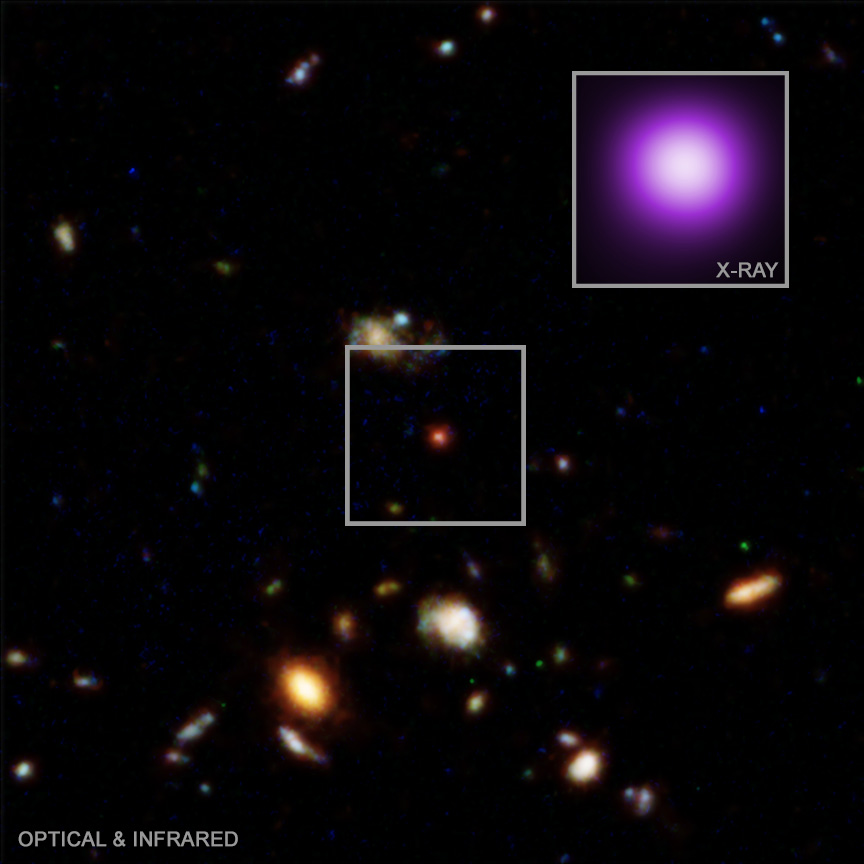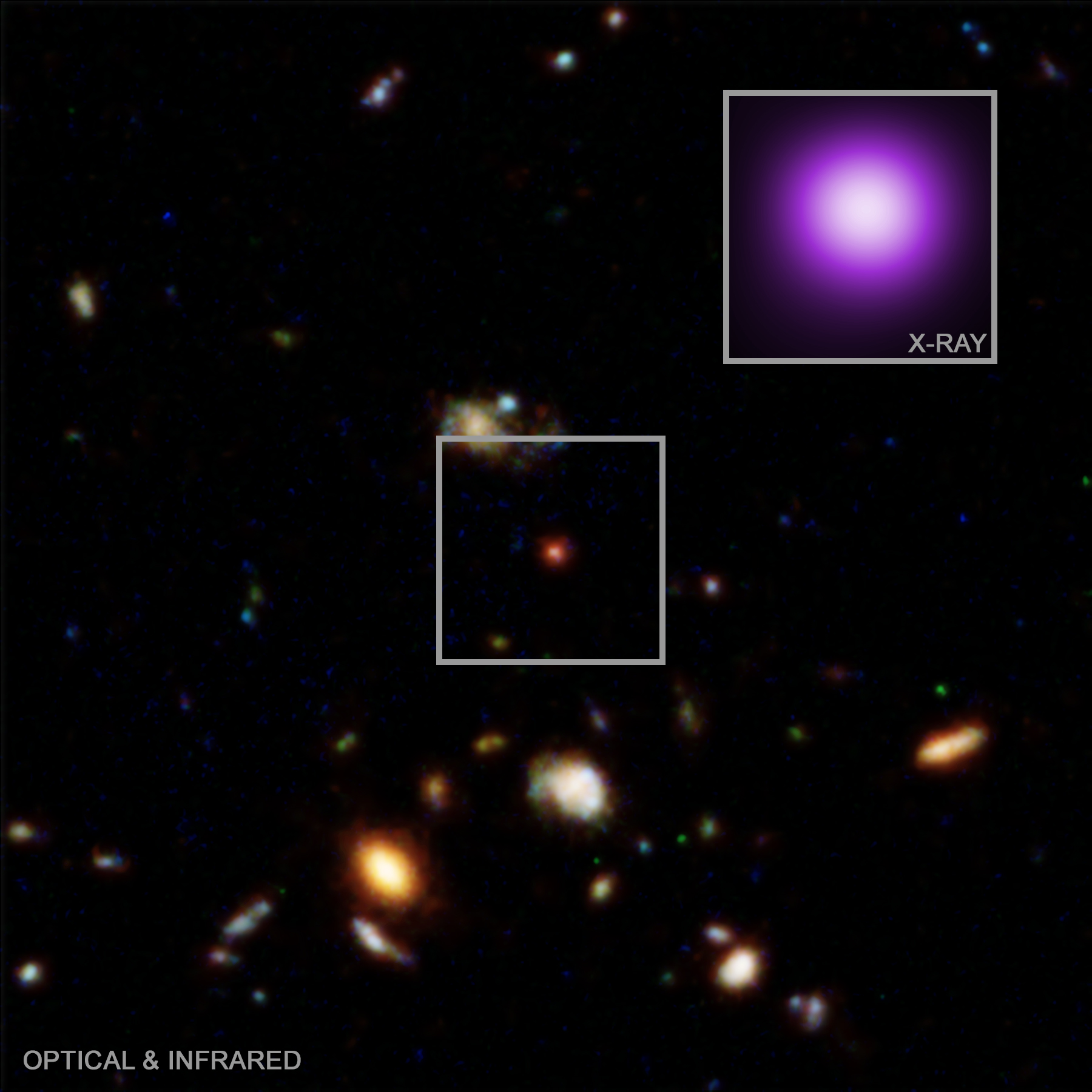

This image of a special object, dubbed the “X-ray dot,” represents a discovery from NASA’s Chandra X-ray Observatory that could help explain the nature of a mysterious class of sources in the early Universe as described in our latest press release. Officially known as 3DHST-AEGIS-12014, the X-ray dot is located about 11.8 billion light-years from Earth and may provide a crucial bridge between young black holes embedded in dense gas and typical growing supermassive black holes.
Shortly after NASA’s James Webb Space Telescope started its science observations, scientists reported a new class of unexplained objects. Astronomers found sources that were relatively small and red and located about 12 billion light-years from Earth or farther. (One reason for this redness is their great distances, causing their light to be shifted toward the part of the infrared spectrum with the longest wavelengths, which results in red colors in Webb images.) These became known as “little red dots” (LRDs), and since then astronomers have been trying to determine what exactly these LRDs are.
Recently, a team of researchers found one special object that could help, the X-ray dot depicted in this graphic. An optical and infrared composite image is centered on the position of the X-ray dot and shows its key features as an LRD – small and red. Optical light from NASA’s Hubble Space Telescope is colored blue and green and infrared light from Hubble is colored orange and red. The Chandra X-ray image of the X-ray dot (purple) is in the inset, showing it is bright in X-rays.
The X-ray dot was discovered when comparing new data from Webb with a deep survey previously performed by Chandra. Up until then, all the other LRDs didn’t appear to emit X-rays. This was perplexing because if LRDs were early black holes, as many suspected they were, then they should commonly produce bright X-rays.
Therefore, it was significant to find an LRD that does. The researchers suggest that the X-ray dot could represent a transition phase from an LRD to a typical growing supermassive black hole. As the black hole in an LRD consumes gas surrounding it, patchy holes in the clouds of gas appear. This allows X-rays from material falling onto the black hole to poke through, which are observed by Chandra. Eventually all the gas is consumed, and the “black hole star” ceases to exist. A snapshot of this scenario is depicted in the artist’s illustration below.
The artist’s impression of the X-ray dot shows the research team’s understanding of this new object: a growing supermassive black hole at the center of a patchy sphere of gas.
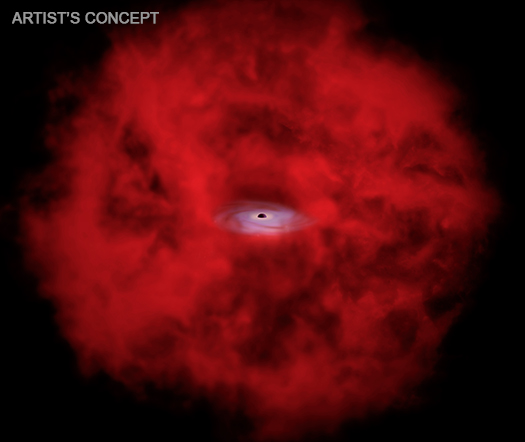
There are also hints in the Chandra data of the X-ray dot that there are variations in X-ray brightness, which supports the idea that the black hole is partly obscured. As the cloud of gas rotates, patches of denser and less dense gas can move across the black hole, causing changes in X-ray brightness.
An alternate idea for the X-ray dot is that it is a more common type of growing supermassive black hole but is veiled in an exotic type of dust that astronomers have not seen before. Future observations are planned that should be able to shed light on the truth.
A paper describing these results has been published in The Astrophysical Journal with the lead author of Raphael Hviding (Max Planck Institute for Astronomy in Germany). A full list of authors can be found in the paper available at https://arxiv.org/abs/2601.09778
NASA's Marshall Space Flight Center in Huntsville, Alabama, manages the Chandra program. The Smithsonian Astrophysical Observatory's Chandra X-ray Center controls science operations from Cambridge, Massachusetts, and flight operations from Burlington, Massachusetts.
Today's release features a composite image with an X-ray insert, and an artist's illustration of a little dot located 11.8 billion light-years from Earth.
Shortly after NASA's James Webb Space Telescope started its observations, reports of a new class of curious objects emerged. Astronomers discovered small red specks more than about 12 billion light-years from Earth. These mysterious objects were given the accurate and descriptive name "little red dots," or LRDs.
One such dot sits at the heart of the primary image of this release. The composite optical and infrared image features a smattering of distant galaxies and other cosmic objects and phenomena in a variety of colors, set against the blackness of space. At the center of the square image is a small, somewhat pixelated, little red dot, outlined in a white box for clarity.
This curious, but inconspicuous, little dot is enlarged in an X-ray insert at our upper right, because it does something no other LRD has been found to do; it emits X-rays! In the insert, the dot appears as a much larger white sphere in the Chandra image, ringed with a neon purple glow. This exciting discovery has earned this little dot the nickname the "X-ray dot."
The X-ray dot is further enlarged in an artist's illustration. Many scientists think LRDs are supermassive black holes embedded in clouds of dense gas. Here, the dot is a round, patchy cloud of brilliant red gas. At its core is a relatively tiny black sphere, the black hole, floating in a swirling pool of pale purple mist. Research suggests that the X-ray dot represents a transition phase from an LRD to a typical growing supermassive black hole. As the black hole star consumes its surrounding gas, patchy holes appear in the cloud. This allows X-rays to poke through, which are then observed by Chandra.
|
||||||||||||||||||||||||||||||