
Supernovas & Supernova Remnants
All Eyes on Oldest Recorded Supernova
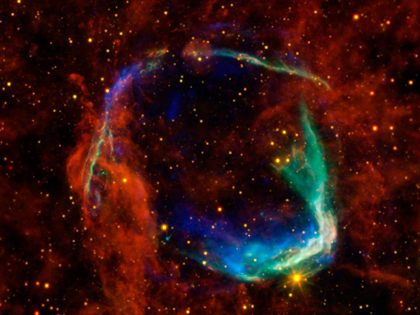
This image combines data from four different space telescopes to create a multi-wavelength view of all that remains of the oldest documented example of a supernova, called RCW 86. The Chinese witnessed the event in 185 A.D., documenting a mysterious "guest star" that remained in the sky for eight months. X-ray images from NASA's Chandra X-ray Observatory and the European Space Agency's XMM-Newton Observatory are combined to form the blue and green colors in the image. The X-rays show the interstellar gas that has been heated to millions of degrees by the passage of the shock wave from the supernova.
A Middle-Aged Supernova Remnant
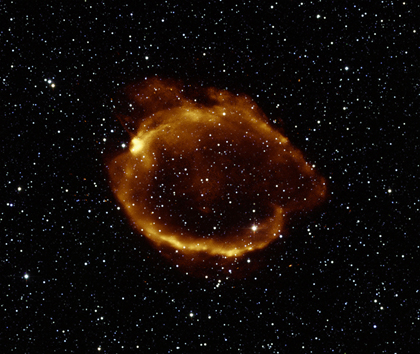
G299.2-2.9 is an intriguing supernova remnant found about 16,000 light years away in the Milky Way galaxy . Evidence points to G299.2-2.9 being the remains of a Type Ia supernova, where a white dwarf has grown sufficiently massive to cause a thermonuclear explosion. Because it is older than most supernova remnants caused by these explosions, at an age of about 4500 years, G299.2-2.9 provides astronomers with an excellent opportunity to study how these objects evolve over time. It also provides a probe of the Type Ia supernova explosion that produced this structure.
The Crab in Action & The Case of The Dog That Did Not Bark
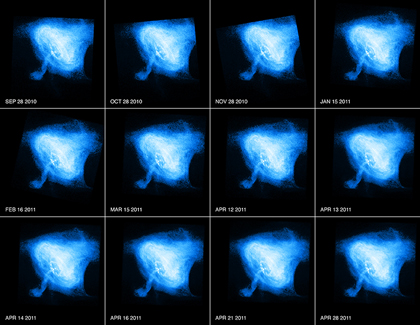
A new movie from NASA's Chandra X-ray Observatory shows a sequence of Chandra images of the Crab Nebula, taken over an interval of seven months. Dramatic variations are seen, including the expansion of a ring of X-ray emission around the pulsar (white dot near center) and changes in the knots within this ring.
NASA'S Chandra Finds New Evidence on Origin of Supernovas
This Chandra image of the Tycho supernova remnant contains new evidence for what triggered the original supernova explosion. Tycho was formed by a Type Ia supernova, a category of stellar explosion used in measuring astronomical distances because of their reliable brightness. In the lower left region of Tycho is a blue arc of X-ray emission. Several lines of evidence support the conclusion that this arc is due to a shock wave created when a white dwarf exploded and blew material off the surface of a nearby companion star.
Exploding Stars and Stripes
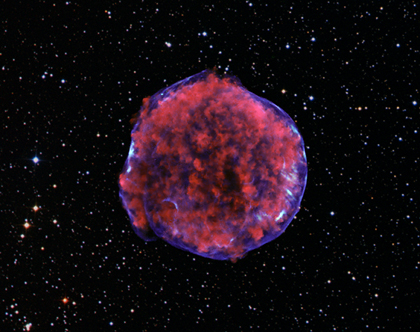
This image comes from a very deep Chandra observation of the Tycho supernova remnant, produced by the explosion of a white dwarf star in our Galaxy. Low-energy X-rays (red) in the image show expanding debris from the supernova explosion and high energy X-rays (blue) show the blast wave, a shell of extremely energetic electrons . These high-energy X-rays show a pattern of X-ray "stripes" never previously seen in a supernova remnant. By rolling the mouse over the color image above, two regions containing stripes in the high energy image can be seen superimposed on the full color version. Some of the brightest stripes can also directly be seen in the full color image, on the right side of the remnant pointing from the outer rim to the interior. The stellar background is from the Digitized Sky Survey and only shows stars outside the remnant.
Chandra Finds Superfluid in Neutron Star's Core
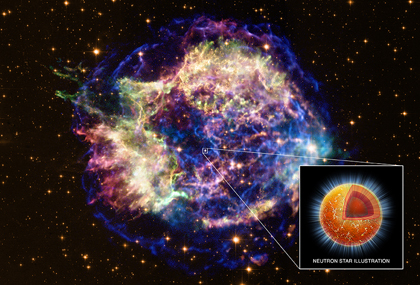
This composite image shows a beautiful X-ray and optical view of Cassiopeia A (Cas A), a supernova remnant located in our Galaxy about 11,000 light years away. These are the remains of a massive star that exploded about 330 years ago, as measured in Earth's time frame. X-rays from Chandra are shown in red, green and blue along with optical data from Hubble in gold.
NASA Finds Youngest Nearby Black Hole
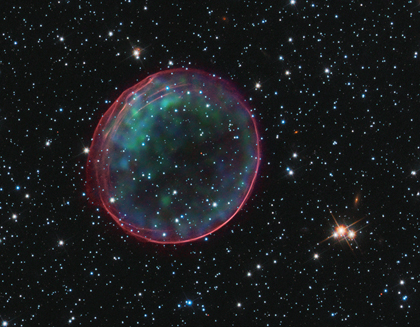
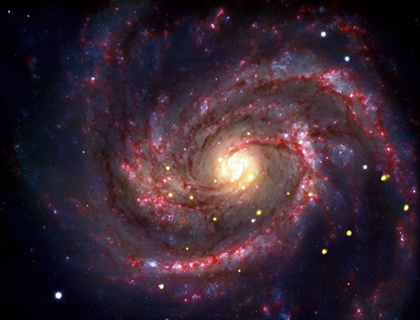
This composite image shows a supernova within the galaxy M100 that may contain the youngest known black hole in our cosmic neighborhood. In this image, Chandra's X-rays are colored gold, while optical data from ESO's Very Large Telescope are shown in yellow-white and blue, and infrared data from Spitzer are red. The location of the supernova, known as SN 1979C, is labeled (roll your mouse over the image above).
Pushing the Envelope
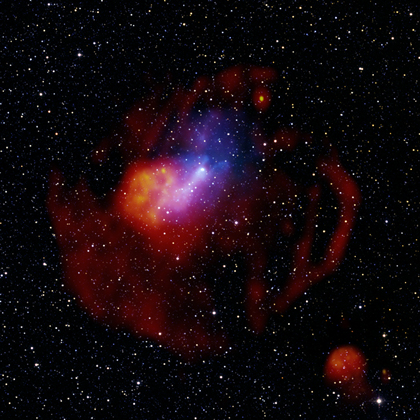
G327.1-1.1 is the aftermath of a massive star that exploded as a supernova in the Milky Way galaxy. A highly magnetic, rapidly spinning neutron star called a pulsar was left behind after the explosion and is producing a wind of relativistic particles, seen in X-rays by Chandra and XMM-Newton (blue) as well as in the radio data (red and yellow). This structure is called a pulsar wind nebula. The likely location of the spinning neutron star is shown in the labeled version. The large red circle shows radio emission from the blast wave, and the composite image also contains infrared data from the 2MASS survey (red, green, and blue) that show the stars in the field.
Stellar Shrapnel Seen in Aftermath of Explosion
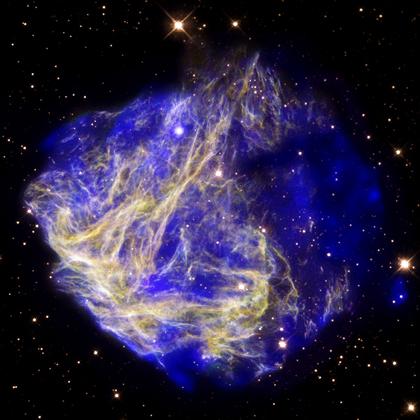
This beautiful composite image shows N49, the aftermath of a supernova explosion in the Large Magellanic Cloud. A new long observation from NASA's Chandra X-ray Observatory, shown in blue, reveals evidence for a bullet-shaped object being blown out of a debris field left over from an exploded star.